ADA Compliance in the Atlanta Startup Ecosystem
Atlanta's tech ecosystem has specific dynamics that make accessibility both more important and more achievable than in many markets.
Enterprise and government contracts require it. Atlanta is home to more Fortune 500 headquarters than almost any other city. Companies like Coca-Cola, Home Depot, UPS, Delta Air Lines, and NCR have vendor accessibility requirements. Startups in Midtown and Buckhead pitching enterprise contracts often discover that ADA compliance is a procurement prerequisite, not a nice-to-have. The same applies to Georgia state government contracts administered through the Georgia Technology Authority, where Section 508 compliance is mandatory.
Atlanta's fintech cluster demands it. The city processes more payment transactions than any other city in the world. Fintech startups building payment interfaces, banking dashboards, and financial tools must meet accessibility standards to serve users who rely on screen readers, keyboard navigation, or voice control. Firms operating near the Hartsfield-Jackson corridor and in Sandy Springs where major payment processors are headquartered face these requirements routinely.
Accelerator and grant programs expect it. Startups connected to Georgia Tech's Advanced Technology Development Center (ATDC), Atlanta Tech Village, Techstars Atlanta, and Invest Atlanta grant programs increasingly face accessibility questions during due diligence. Demonstrating WCAG compliance signals maturity and reduces risk for investors and program administrators.
Atlanta's diverse population values it. Atlanta has one of the most diverse metro populations in the Southeast. The city's commitment to inclusion, visible in organizations like the Shepherd Center (one of the nation's leading rehabilitation hospitals located in Buckhead) and the Bobby Dodd Institute in Midtown, creates a market expectation that digital experiences are accessible to everyone.
Common Accessibility Issues in Atlanta Startup Websites
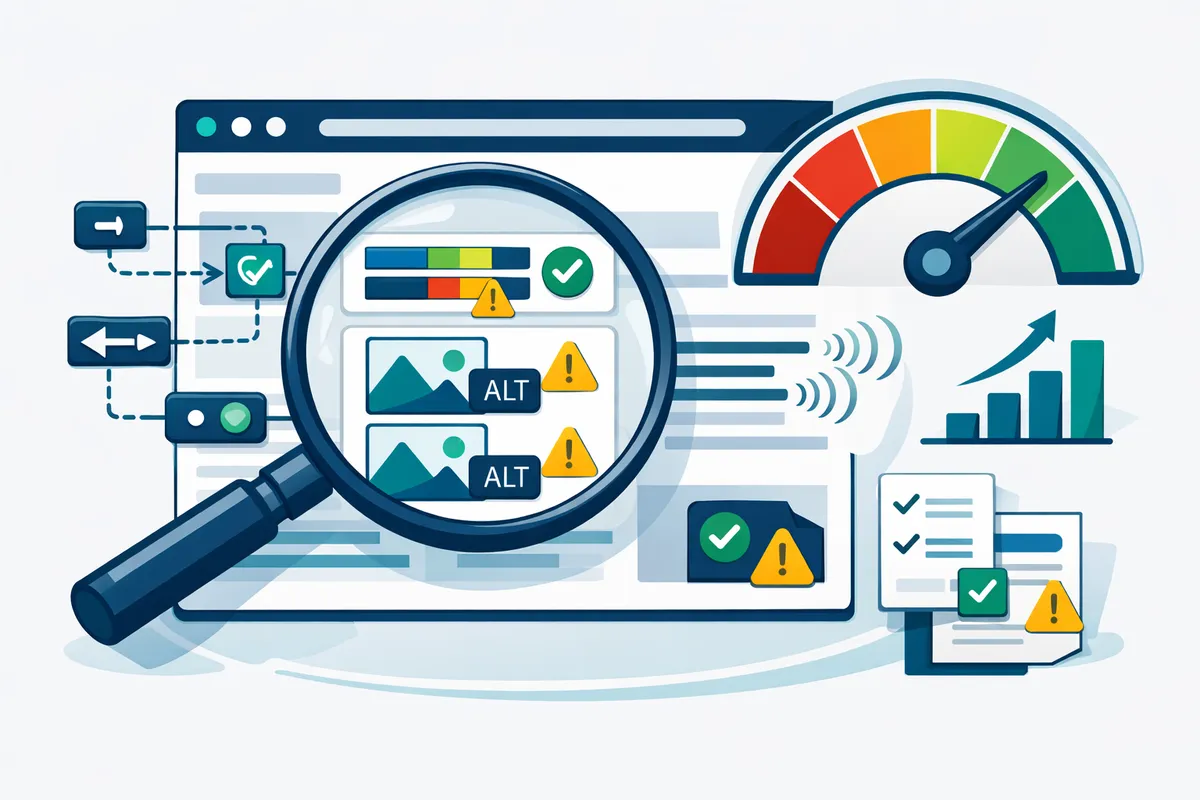
An automated scan catches approximately 30 to 40 percent of WCAG violations. The rest require manual testing with assistive technologies. Here are the issues we find most frequently when auditing Atlanta startup websites.
Missing or decorative alt text on meaningful images. Every image that conveys information needs descriptive alt text. Logos, product photos, infographics, and screenshots all require alt attributes that describe what the image communicates. Stock photos of Atlanta landmarks, Piedmont Park, or the BeltLine used as hero images need appropriate descriptions when they convey meaning.
Insufficient color contrast. WCAG 2.1 AA requires a minimum contrast ratio of 4.5:1 for normal text and 3:1 for large text. Many Atlanta startup brand palettes fail this test, particularly light grays on white backgrounds and colored text on colored backgrounds. This is especially common among startups using trendy minimal design aesthetics popular in the Ponce City Market and Old Fourth Ward creative scene.
Forms without proper labels. Placeholder text inside input fields is not a label. Screen readers need explicit label elements associated with each form control via the for attribute. Floating labels that disappear on focus create problems for users with cognitive disabilities who lose context about what the field requires. Contact forms, demo request forms, and newsletter signups on Atlanta startup sites frequently have this issue.
Keyboard navigation dead ends. Custom dropdown menus, modal dialogs, and hamburger menus built without keyboard support trap users who cannot use a mouse. Every interactive element needs focus states, and focus order must follow a logical reading sequence. Tab through your entire site without touching your mouse. If you get stuck or lost, so do your users.
Missing skip navigation links. Screen reader users hear every navigation link on every page load unless you provide a "Skip to main content" link as the first focusable element. This is one of the simplest fixes and one of the most commonly missing.
Video and audio without captions. Auto-generated captions from YouTube are approximately 70 to 80 percent accurate, which is not sufficient for compliance. Professional captions or verified auto-captions are necessary. Atlanta startups using video for product demos, founder stories, and customer testimonials need proper captioning.
Dynamic content that fails to announce updates. Single-page applications that update content without a full page reload need ARIA live regions to alert screen readers when content changes. Toast notifications, form validation messages, and loading states all require proper announcement.
Building Accessibility Into Your Design System
Retrofitting accessibility onto a finished website costs three times as much as building it in from the start. The efficient approach for Atlanta startups is building accessibility into your component library from day one.
Start with semantic HTML. Use nav, main, article, aside, header, and footer elements. These landmarks give screen readers a map of your page structure. A div with a click handler is not a button. Use button elements for actions and anchor elements for navigation.
Build an accessible color system. Test every color combination in your palette for contrast compliance before finalizing your brand guidelines. Create a contrast matrix that shows which colors can pair for text and background. This prevents designers from accidentally creating inaccessible combinations during rapid iteration cycles common in Atlanta startup environments.
Design focus states explicitly. The default browser focus ring is functional but often removed for aesthetic reasons. Replace it with a visible, on-brand focus indicator that meets the 3:1 contrast requirement against adjacent colors. Every interactive element needs a visible focus state.
Create accessible component patterns. Build your modal, dropdown, accordion, tab, and tooltip components with keyboard support and ARIA attributes from the first version. Document the accessibility requirements alongside the design specs. When your website uses a shared component library, accessibility becomes automatic rather than an afterthought.
Write an accessibility style guide. Document your heading hierarchy rules (one H1 per page, no skipped levels), alt text guidelines, link text requirements (no "click here"), and color usage rules. Give this guide to every developer and content creator who touches your site.
Automated Testing and Monitoring
Manual accessibility audits are essential but expensive at $2,000 to $10,000 per audit depending on site complexity. Automated tools catch a subset of issues continuously between manual reviews.
Axe DevTools integrates into your browser and CI/CD pipeline. It catches approximately 57 percent of WCAG violations automatically and produces actionable error reports with severity ratings. Running Axe in your build pipeline prevents new violations from reaching production.
Lighthouse Accessibility Audit is built into Chrome DevTools and scores your pages on a 0 to 100 scale. Scores above 90 indicate strong automated compliance, though a perfect score does not guarantee full WCAG conformance because many criteria require human judgment.
Pa11y runs automated tests against a list of URLs and generates reports. It integrates with CI systems and can block deployments when accessibility scores drop below a threshold.
WAVE provides a browser extension that overlays accessibility information directly on your page, highlighting errors, alerts, and structural elements visually.
For ongoing monitoring, combine automated scans running weekly or on every deployment with quarterly manual audits using real assistive technology.
The Business Case Beyond Legal Risk
Accessibility improvements correlate with measurable business outcomes that matter to Atlanta startups beyond lawsuit prevention.
SEO benefits. Many accessibility practices directly improve search rankings. Alt text helps Google understand images. Proper heading hierarchy helps crawlers parse content structure. Semantic HTML improves content indexability. Businesses that implement WCAG guidelines often see a 12 to 15 percent improvement in organic search traffic from structural improvements alone. For Atlanta startups competing for local search visibility against established businesses in Buckhead, Decatur, and Alpharetta, this edge compounds.
Conversion rate improvements. Clear form labels, logical navigation, readable text, and fast-loading pages benefit all users. Accessible websites have measurably lower bounce rates than comparable inaccessible sites. When every user can complete your conversion flow without friction, conversion rates rise.
Mobile performance. WCAG requirements around touch targets (minimum 44x44 CSS pixels), readable text without zooming, and logical content flow directly improve the mobile experience. Mobile traffic exceeds 60 percent for most startup websites. Atlanta commuters browsing on MARTA, at Hartsfield-Jackson, or walking the BeltLine are mobile-first users. Accessibility and mobile optimization share significant overlap.
Brand reputation. Companies that demonstrate accessibility commitment attract talent, earn positive coverage in disability advocacy communities, and differentiate themselves in markets where competitors have not made the investment. For Atlanta startups building their brand identity in a competitive ecosystem, accessibility signals maturity and social awareness.
Remediation Roadmap for Existing Atlanta Startup Websites
If your site is already live with accessibility gaps, here is a prioritized remediation approach.
Week 1 to 2: Critical fixes. Address issues that completely block access. Missing form labels, keyboard traps, missing alt text on functional images, and color contrast failures on primary CTAs. These are the violations most likely to trigger legal complaints.
Week 3 to 4: Structural improvements. Add proper heading hierarchy, landmark regions, skip navigation, and language attributes. Fix focus management in modals and dynamic content.
Month 2: Content remediation. Add captions to all videos. Write alt text for remaining images. Review link text for clarity. Ensure PDFs and downloadable documents are accessible or provide HTML alternatives.
Month 3: Testing and documentation. Conduct a full manual audit with screen readers. Document your accessibility statement. Establish ongoing testing processes and train your content team on accessibility requirements.
Ongoing. Run automated scans on every deployment. Schedule quarterly manual reviews. Update your accessibility statement annually.
Why Atlanta Startups Choose Running Start Digital
We help Atlanta startups treat accessibility as a design principle, not a legal checkbox. Your website should work for every user across metro Atlanta, from Georgia Tech students using screen readers to professionals in Sandy Springs navigating with keyboard-only input to entrepreneurs in Old Fourth Ward accessing your site on mobile.
We understand the Atlanta ecosystem. We know the compliance requirements that enterprise clients in Buckhead demand. We know the accessibility standards that ATDC and Invest Atlanta programs expect. We build websites that meet those standards from day one, protecting your legal position while expanding your addressable market to include the 1.6 million metro Atlanta residents living with disabilities.
Frequently Asked Questions
Q: How much does ADA compliance cost for an Atlanta startup website?
For a new build, adding WCAG 2.1 AA compliance typically adds 1 to 3 percent to the total development cost, roughly $500 to $3,000 on a $30,000 to $100,000 project. Remediating an existing site ranges from $2,000 for a simple 5-page site to $15,000 or more for complex web applications. Ongoing monitoring and maintenance runs $100 to $500 per month depending on site size and update frequency.
Q: Can my Atlanta startup get sued for an inaccessible website even if we are small?
Yes. ADA web accessibility lawsuits have targeted businesses of all sizes, including sole proprietors and early-stage startups. Plaintiffs' attorneys use automated scanning tools to identify violations across thousands of websites, then file demand letters in bulk. Business size is not a defense. The Northern District of Georgia has seen increasing filing activity, and Atlanta businesses are not exempt from this national trend.
Q: Do accessibility overlay widgets actually work?
No. Accessibility overlay products that add a toolbar widget to your site do not achieve WCAG compliance. Multiple court rulings have rejected overlay solutions as adequate remediation. The National Federation of the Blind has explicitly opposed overlay products. These tools can introduce new accessibility barriers by interfering with assistive technology. Genuine compliance requires fixing the underlying code.
Q: Is WCAG 2.1 AA the only standard my Atlanta startup needs to meet?
WCAG 2.1 AA is the standard most courts and settlement agreements reference. WCAG 2.2 was published in October 2023 with nine new success criteria. While courts have not widely adopted 2.2 yet, building to the newer standard future-proofs your compliance. If your Atlanta startup works with Georgia state agencies or receives federal funding, Section 508 requirements also apply.
Q: What is the fastest way to test if my current site has major accessibility issues?
Run three quick tests. First, tab through your entire homepage using only your keyboard. If you cannot reach every interactive element or if you get trapped in a component, you have critical issues. Second, run the free WAVE browser extension and review the red error icons. Third, turn on VoiceOver (Mac: Cmd+F5) or NVDA (Windows, free download) and try to navigate your homepage by listening only. These three tests take under 30 minutes combined and reveal the most impactful problems.
Q: How do Atlanta enterprise clients verify ADA compliance during procurement?
Many Fortune 500 companies headquartered in Atlanta include a Voluntary Product Accessibility Template (VPAT) requirement in their vendor evaluation process. A VPAT documents your product's conformance with WCAG standards. Having a current VPAT ready positions your startup as a mature vendor that takes compliance seriously. We help Atlanta startups prepare VPATs as part of our accessibility services.