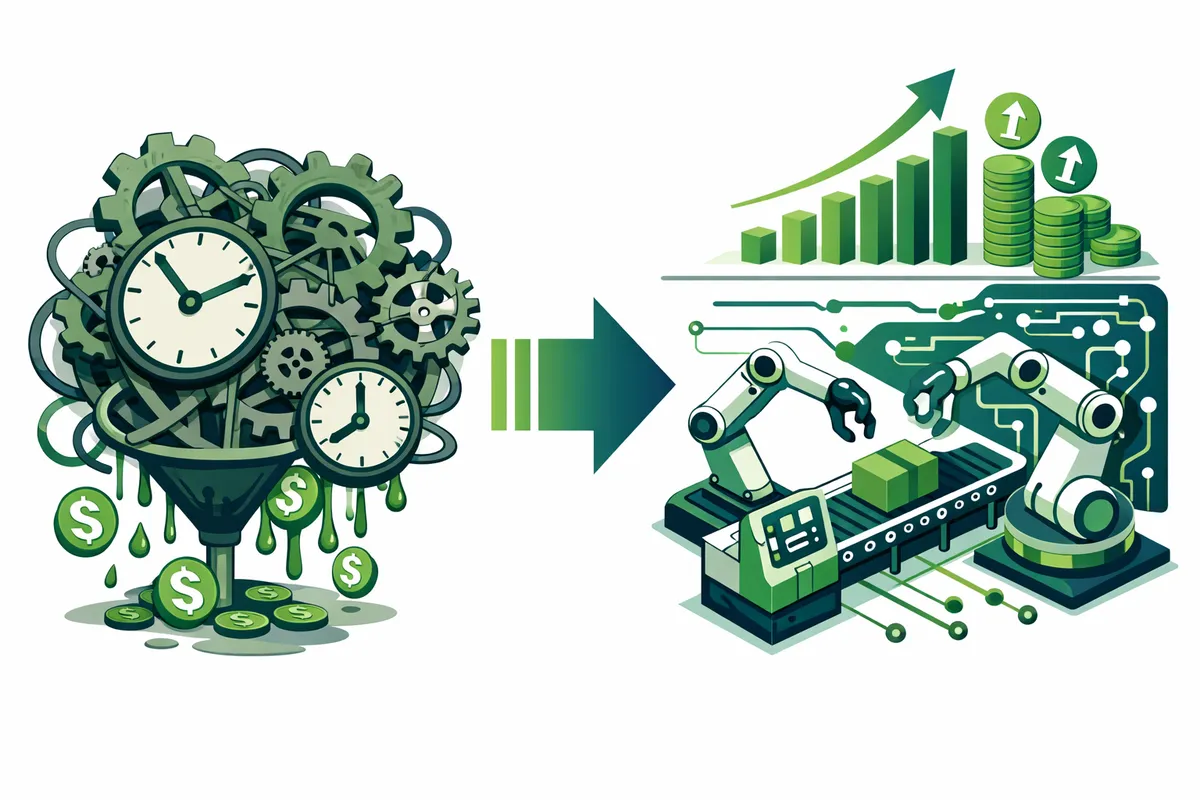
High-Value Automation Opportunities by Department
Finance and Accounting
Invoice processing. Manual AP costs $12 to $15 per invoice. Automated AP reduces that to $2 to $4. A company processing 300 invoices monthly saves $24,000 to $39,600 annually.
Expense report processing. Manual reports take 20 to 30 minutes per submission and 10 to 15 minutes for approval. At 50 reports monthly, that is 25 to 37 hours of labor. Automation reduces submission to 5 minutes with receipt scanning and policy enforcement.
Financial reporting. Monthly close processes requiring data from 5 systems consume 20 to 40 hours. Automated data aggregation reduces this to 4 to 8 hours of review.
Sales and Marketing
Lead routing. Leads waiting more than 5 minutes for response have 80 percent lower conversion. Automated routing assigns leads instantly based on territory, product interest, or round-robin rules. For Atlanta B2B companies, routing by geographic territory (Buckhead enterprise accounts to senior reps, Midtown startup leads to the growth team) ensures the right rep handles the right prospect.
Proposal generation. Sales teams spend 3 to 8 hours per proposal on work that is 80 percent repetitive. Automation reduces creation to 30 minutes by pulling customer data from CRM, applying pricing rules, and generating formatted documents.
CRM data maintenance. Reps spend 5 to 8 hours weekly on CRM entry. Automated activity logging, email sync, and deal stage updates reclaim those hours for selling.
Customer Operations
Customer onboarding. Manual onboarding takes 2 to 4 hours per new customer. Automated sequences handle document collection, account provisioning, welcome communications, and training scheduling. A company onboarding 20 customers monthly saves 40 to 80 hours.
Support ticket routing. Automated classification, priority assignment, and routing cuts first-response time from hours to minutes.
Renewal management. Automated reminders starting 90 days before expiration prevent revenue leakage. Companies automating renewals see 10 to 15 percent improvement in renewal rates.
Calculating ROI for Your Atlanta Business
Step 1: Process Audit
Map every repeatable process in the target department. Document who performs it, frequency, time per instance, tools involved, and common errors. Spend 2 to 3 days on this audit.
Step 2: Cost Current State
Formula: hours per instance times frequency per year times loaded hourly rate equals annual labor cost. Add error costs: error rate times volume times average cost per error.
Example: Invoice processing at 20 minutes per invoice, 400 invoices monthly, $24 per hour loaded cost. Annual labor: $38,016. Annual error costs at 3 percent rate: $7,200. Total current cost: $45,216.
Step 3: Estimate Automation Cost
Simple automation (connecting two systems): $2,000 to $8,000 one-time plus $200 to $500 monthly. Moderate automation (multi-system workflow): $8,000 to $25,000 one-time plus $500 to $1,500 monthly. Complex automation (AI-powered, multi-department): $25,000 to $75,000 one-time plus $1,500 to $4,000 monthly.
Atlanta's development costs are generally 20 to 30 percent lower than coastal markets for comparable quality, making automation investments more attractive.
Step 4: Calculate Payback Period
Payback equals implementation cost divided by monthly savings. Invoice processing example: $15,000 implementation divided by $3,768 monthly savings equals 4.0 months to payback. Over 3 years, the $15,000 investment returns $120,432 in cumulative savings, an 8x return.
Step 5: Prioritize by ROI and Complexity
Rank opportunities on ROI magnitude and implementation complexity. Start with high-ROI, low-complexity automations. Quick wins generate savings that fund more complex projects.
Implementation Approach
Phase 1: Quick wins (Weeks 1 to 4). Implement the 2 to 3 highest-ROI automations with simplest implementation. Typical quick wins: lead routing, invoice data extraction, customer communication sequences.
Phase 2: Core workflows (Weeks 5 to 12). Moderate-complexity automations targeting largest absolute savings. Full AP automation, customer onboarding sequences, reporting pipelines.
Phase 3: Advanced automation (Weeks 13 to 24). AI-powered automations, predictive workflows, complex multi-department processes.
Phase 4: Optimization (Ongoing). Monitor performance, adjust rules, identify new opportunities. Automation compounds in value as you extend it across operations.
Measuring and Optimizing
We track five metrics for every automation:
Time saved per period. Actual hours reclaimed, measured by comparing pre and post-automation process duration.
Error rate. Target below 1 percent of automated transactions requiring manual correction.
Processing volume. Transactions handled per period, revealing whether automation enables growth without headcount increases.
Exception rate. Transactions routed to human review. High rates indicate rules need refinement.
Cumulative financial impact. Running total of labor savings, error cost avoidance, and revenue gains.
Monthly reviews ensure automations continue performing. As your Atlanta business evolves, automations need adjustment. We maintain and improve your automations to deliver maximum value.
Why Atlanta Businesses Choose Running Start Digital
We approach automation as a business investment, not a technology project. Every automation has a clear ROI target and measurement framework. You know what you are getting and what it is worth before we build it.
Atlanta's business ecosystem rewards lean operations. The companies that thrive in Midtown, Buckhead, Sandy Springs, and across the metro area are the ones that use technology to multiply their team's effectiveness rather than simply adding headcount. Automation is the highest-leverage investment most Atlanta businesses can make.
Your team's time is your most valuable resource. Automation frees that time for work that actually grows your business: closing deals, serving customers, developing products, and building relationships.
Frequently Asked Questions
Q: What is a realistic ROI expectation for business automation?
Most projects deliver 200 to 500 percent ROI in the first year. Simple automations targeting high-volume processes often deliver 10x or higher. Complex automations typically deliver 3 to 5x in year one with increasing returns as maintenance costs remain stable while savings compound.
Q: How quickly do automation projects pay for themselves?
Simple automations pay back in 4 to 8 weeks. Moderate-complexity projects in 3 to 6 months. Complex implementations in 6 to 12 months. The key variable is process volume.
Q: Which processes should we automate first?
Start with processes that are high-volume, rule-based, cross-system, and consuming significant staff time. Invoice processing, lead routing, customer communication, and report generation consistently rank as highest-ROI first automations.
Q: Will automation eliminate jobs on our Atlanta team?
In our experience, automation eliminates tasks, not positions. Team members freed from manual work are redeployed to higher-value activities. Companies that automate effectively grow faster, creating new roles that did not exist before automation.
Q: How much does business process automation cost?
Implementation ranges from $2,000 for simple integrations to $75,000 for complex AI-powered workflows. Most Atlanta small businesses start with $5,000 to $15,000 targeting 2 to 3 high-ROI processes. Ongoing maintenance runs 10 to 20 percent of implementation cost annually.
Q: Can we automate processes if our current tools do not have APIs?
Often, yes. For tools with web interfaces but no APIs, browser-based automation (RPA) interacts with the application like a human would. For tools with database access, direct integrations work. We evaluate your specific stack and recommend the most practical approach.