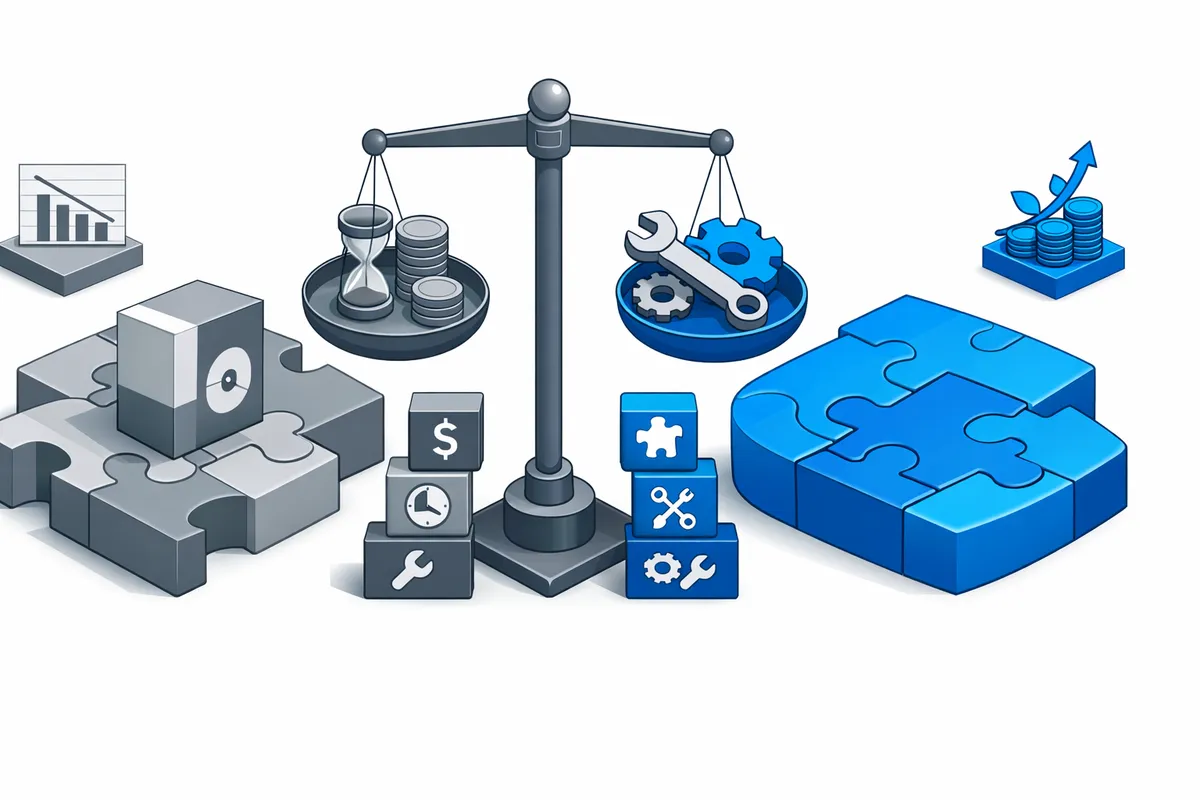
When Custom Software Creates Advantage
Custom makes sense when your core processes are unique and that uniqueness creates competitive advantage.
Your process IS your product. SaaS platforms, marketplaces, and customer portals need custom development by definition. Atlanta fintech startups building payment solutions, health tech companies creating patient platforms, and logistics firms building tracking systems all fall into this category.
You have outgrown existing tools. When your team has tried 3-plus solutions and each fails on the same critical requirements, the market is telling you that your needs fall outside standard use cases. Common symptoms: excessive workarounds, manual processes negating tool efficiency, and team frustration driving low adoption.
Data is your competitive advantage. Businesses collecting unique data and using it for better decisions need custom systems. An Atlanta retailer with proprietary demand forecasting, a healthcare provider with outcome prediction models, or a logistics company with route optimization all benefit from custom software built around their specific data.
Integration depth matters. Deep, bidirectional integration with legacy systems or specialized hardware goes beyond what off-the-shelf connectors support. Atlanta's mature business environment includes companies with established systems that need careful integration, not replacement.
Examples of Custom Software Creating Value in Atlanta
A 50-person professional services firm in Buckhead replaced 5 SaaS tools with one custom platform. Annual software spend dropped from $72,000 to $15,000 in hosting and maintenance. The 4-tool workflow that required manual data transfer now runs in one system, saving 200 hours monthly.
A fintech startup in Sandy Springs built a custom compliance portal integrating with payment processing systems. The portal reduced customer onboarding from 48 hours to 2 hours and eliminated the compliance errors that manual processing created.
A logistics company near Hartsfield-Jackson built custom dispatch software that factors in flight schedules, ground transportation timing, and warehouse capacity. The system reduced delivery delays by 35 percent and allowed the same operations team to handle 3x the order volume.
Cost Analysis: Short-Term vs Long-Term
Year 1
Off-the-shelf (10 users): $24,000 to $100,000 total including subscriptions, setup, integration, and training. Custom: $53,000 to $258,000 including development, training. Off-the-shelf wins in year 1.
5-Year Total Cost of Ownership
Off-the-shelf (10 to 20 users): $165,000 to $600,000 including cumulative subscriptions, integration maintenance, and productivity cost of workarounds. Custom: $173,000 to $598,000 including hosting, maintenance, feature development, and integration maintenance.
Over 5 years, costs converge. Custom has higher upfront but lower ongoing. The breakeven typically falls between year 2 and year 4. Atlanta's lower development rates shift this breakeven earlier than in coastal markets.
When Custom Is Clearly Cheaper
Custom becomes financially obvious when you replace 5-plus SaaS subscriptions, your team exceeds 20 users (per-seat pricing compounds), you plan 5-plus years of use, workaround costs exceed $50,000 annually, or you need unsupported integrations.
The Hybrid Approach
Most Atlanta businesses benefit from a combination. Use off-the-shelf for standard functions. Build custom for competitive differentiators.
Buy: Accounting, email, team chat, file storage, basic marketing tools. Commodity functions where custom adds no competitive value.
Build: Customer-facing portals, proprietary workflow tools, internal platforms encoding unique processes, analytics dashboards with proprietary metrics, integration layers connecting disparate systems.
Evaluate case-by-case: CRM, project management, support tools, booking systems. Sometimes off-the-shelf works perfectly. Sometimes your process warrants custom.
A typical hybrid architecture for an Atlanta business: QuickBooks for accounting, custom client portal for customer interactions, HubSpot for marketing automation integrated via API, custom analytics dashboard pulling from all systems, Slack for internal communication. The custom components connect to off-the-shelf tools through documented APIs. Data flows automatically.
Making the Decision: A Practical Framework
Step 1: Audit your current stack. List every tool, monthly cost, user count, workflow fit (1 to 10), weekly workaround hours, and integration pain points.
Step 2: Identify differentiators. Which processes make you different? Which create the most customer value? These are candidates for custom.
Step 3: Calculate true costs. Project total cost of ownership over 3 to 5 years including all hidden costs. Many Atlanta businesses are surprised that custom is cheaper over a 3-year horizon.
Step 4: Assess technical readiness. Can you maintain custom software internally or through a trusted partner? Atlanta's development community provides strong options for ongoing maintenance.
Step 5: Start small. Build one high-impact module rather than replacing your entire stack. Prove value in one area before expanding.
Why Atlanta Businesses Choose Running Start Digital
We build custom software and integrate off-the-shelf platforms. Our recommendations are genuinely unbiased. We recommend custom only when it creates clear, measurable advantages.
Atlanta's technology landscape, anchored by Georgia Tech talent, the Atlanta Tech Village ecosystem, and competitive development rates, makes custom software more accessible than in many markets. We help you take full advantage of these local dynamics.
Your technology decisions shape your business for years. We help you make those decisions with clear analysis, honest trade-off assessments, and the technical expertise to execute whichever path delivers the best return for your specific situation.
Frequently Asked Questions
Q: At what company size does custom software make sense?
No universal threshold, but patterns emerge. Companies with 10 to 20 employees start feeling off-the-shelf limitations. Companies with 20 to 50 usually have at least one custom system. The real trigger is process uniqueness and SaaS spend. A 15-person Atlanta company spending $80,000 yearly on SaaS with significant workarounds has a strong case.
Q: How long does custom software development take?
Single-purpose application: 2 to 4 months. Comprehensive business platform: 4 to 9 months. Complex systems with AI and integrations: 6 to 12 months. We recommend phased delivery: launch core at 3 months, add features in subsequent releases.
Q: What if requirements change after development starts?
Requirements always change. Good practices account for this through modular architecture, iterative development with regular review, and clear change management. We use 2-week sprints with demos and feedback. Course corrections happen frequently and cheaply.
Q: Can custom software integrate with our existing off-the-shelf tools?
Yes. Modern development uses APIs to connect systems. Most SaaS tools provide APIs specifically for this purpose. Integration is standard, not an afterthought.
Q: What happens if the development company goes out of business?
Manageable risk. Protect yourself: code lives in your repository, maintain architecture documentation, use common technologies with large developer communities, get deliverable code any competent developer can maintain. Following these practices, transitioning partners is straightforward.
Q: Should I build custom software or hire more people?
Compare directly. If manual processes require 2 people at $50,000 each ($100,000 annually), and custom software costs $75,000 with $15,000 yearly maintenance, the software pays for itself in under 12 months. Software scales without proportional cost increases. For Atlanta businesses benefiting from competitive labor costs, the comparison still favors automation for repetitive, rule-based processes.