What Good Internal Tools Look Like
The best internal tools share three qualities: simple, fast, and focused.
Single-purpose tools that eliminate specific pain points. A customer lookup tool pulling data from CRM, payment system, and support tickets into one view. An order management dashboard showing status, exceptions, and available actions in real time. A reporting tool that generates the weekly report your Buckhead operations manager builds manually every Friday. Each tool solves one clear problem completely.
Interfaces that require zero training. If your team needs a manual, the tool is too complex. Tables look like familiar spreadsheets. Buttons are labeled with the action they perform. Status indicators use obvious colors and icons. A new hire should be productive within their first hour. For Atlanta businesses with seasonal staff or high-growth hiring, zero-training interfaces mean productivity from day one.
Speed that matches human thought. Internal tools must be fast. When a support agent is on the phone with an Atlanta customer, a lookup tool that takes 8 seconds to load is too slow. Best tools return results in under 500 milliseconds. Server-rendered applications with optimized database queries and smart caching deliver this consistently.
Mobile and tablet support where it matters. Atlanta warehouse teams, field service workers, and managers moving between meetings at Ponce City Market and Sandy Springs offices need tools that work on tablets and phones.
Common Types of Internal Tools We Build
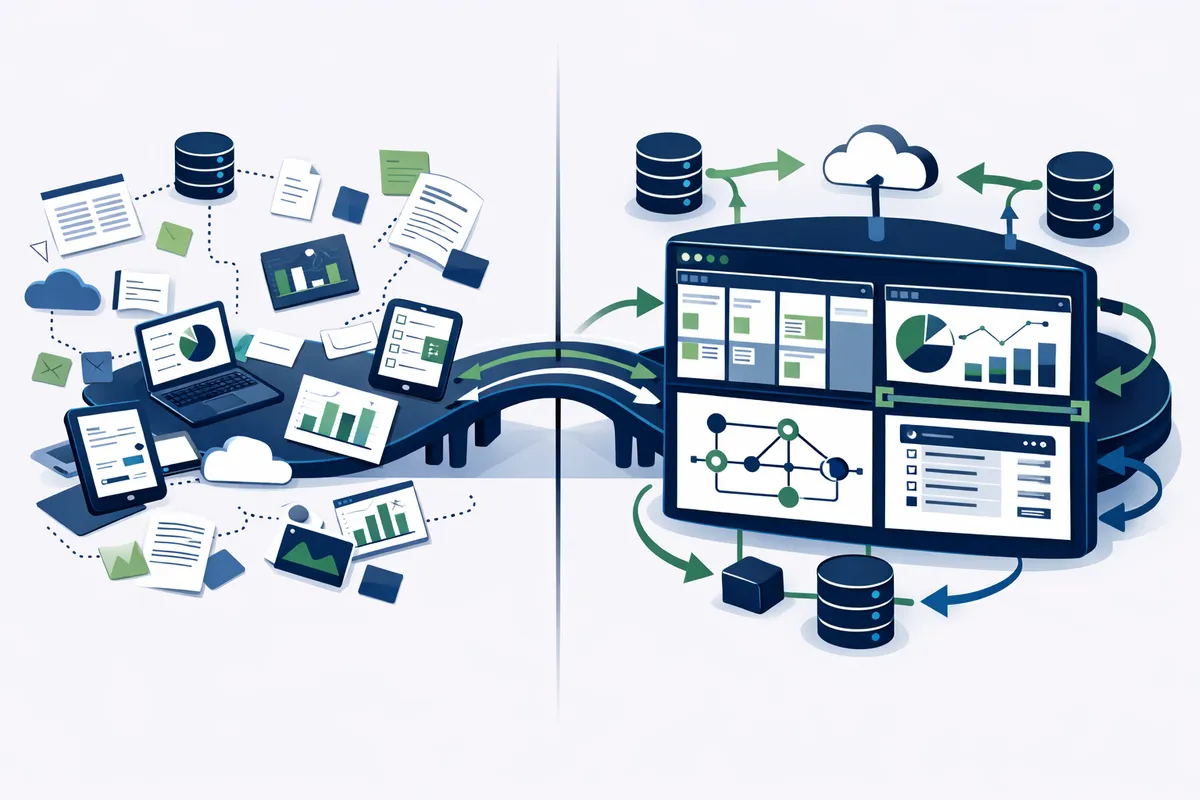
Admin panels and back-office dashboards. Centralized views of business activity. Order status, customer accounts, inventory levels, and key metrics in one place. Replaces the morning routine of logging into six different services to see what happened overnight.
Workflow and approval systems. Purchase order approvals, content review pipelines, employee onboarding checklists, and client intake processes. Custom workflows enforce sequences, notify the right people, and create audit trails. An Atlanta professional services firm processing client intake across Buckhead and Midtown offices needs workflow tools that keep both locations synchronized.
Data entry and collection tools. Field inspection forms, customer intake questionnaires, inventory count interfaces. Validate data on entry, calculate derived values automatically, and push results to core systems without manual export/import. For Atlanta construction, property management, and field service companies, mobile data collection tools eliminate the clipboard-to-spreadsheet-to-database process.
Reporting and analytics dashboards. Real-time visualizations of the metrics your team needs for decisions. Unlike generic BI tools, custom dashboards show exactly your KPIs, in your preferred format, with drill-down capabilities. Atlanta executives get the answers they need without waiting for an analyst to run queries.
Integration hubs. Connect systems that do not natively communicate. Your booking platform, invoicing system, and project management tool share data automatically. Eliminates hours of weekly manual syncing across systems.
Technology Choices for Internal Tools
Internal tools do not need cutting-edge technology. They need reliable, maintainable technology.
For data-heavy tools. Server-rendered applications built with Next.js provide fast loads and handle complex data displays. PostgreSQL handles querying needs with room to grow. TanStack Table provides sorting, filtering, and pagination for grids handling thousands of rows.
For workflow tools. React with form libraries like React Hook Form provide robust validation, multi-step flows, and conditional logic. Server-side validation ensures data integrity.
For dashboards. Chart libraries like Recharts render metrics and trends. WebSockets or server-sent events keep dashboards current without manual refreshes. Responsive CSS ensures dashboards work on 27-inch monitors and tablets.
API integrations. REST and GraphQL APIs connect your tool to existing systems. Data flows between CRM, accounting, project management, and databases without manual intervention. Error handling, retry logic, and logging ensure you know immediately when a sync fails.
Atlanta's strong developer ecosystem, anchored by Georgia Tech graduates and the broader tech community, means these technologies have broad local support for long-term maintenance and evolution.
The Build Process
Discovery (1 to 2 weeks). Interview the people who will use the tool daily. Shadow them performing current processes. Document every step, workaround, and frustration. Discovery interviews typically reveal that the process the team follows differs from what management believes the process is. For Atlanta businesses with multiple office locations or hybrid teams, discovery includes observing workflows across all locations.
Design (1 to 2 weeks). Wireframes and user flows reviewed with actual users. Two rounds of review with end users catches 80 percent of usability issues before a single line of code is written.
Build (3 to 6 weeks). Develop in phases, delivering working features every one to two weeks. Each delivery gives the team something to test in their real workflow. Building iteratively means week-two feedback informs week-three development. Problems surface early when they are cheap to fix.
Deploy and iterate (ongoing). Launch with a subset of users. Monitor adoption, collect feedback, fix issues quickly. Expand to full team after initial group validates reliability. Plan for a month of active adjustment after launch.
Maintenance and Evolution
Internal tools evolve with your business. New product lines, changes in approval hierarchy, new integration requirements.
Clean architectures make modification straightforward. New fields, workflow steps, and integrations can be added without rebuilding from scratch. As your Atlanta business grows from 10 to 50 people, the tool scales with you.
Regular maintenance keeps tools reliable. Security patches, dependency updates, database optimization, and performance monitoring. Neglecting maintenance leads to the same frustrations that made you build the tool in the first place.
Usage analytics reveal opportunities. Track which features your team uses most, where they spend the most time, and which workflows have high drop-off rates. A feature that 40 percent of users work around tells you it does not meet their needs.
ROI Calculation Framework
Step 1: Current cost. People times time per person per week times loaded hourly rate times 52 weeks. Three people spending 45 minutes daily at $40 per hour loaded cost equals $23,400 per year.
Step 2: Post-tool cost. Same process with the tool. 45 minutes reduced to 10 minutes. New annual cost: $5,200. Annual savings: $18,200.
Step 3: Compare to build cost. Tool costs $20,000 to build, $3,000 per year to maintain. Breaks even in 14 months. Saves $15,200 every subsequent year. Over five years: $73,000 return on $32,000 investment.
Step 4: Intangibles. Reduced errors, faster onboarding, improved satisfaction, better data quality. Teams that stop fighting their tools produce better outcomes across every metric.
Why Atlanta Businesses Choose Running Start Digital
We build tools that Atlanta teams actually use. Our development process starts with understanding your workflows and ends with a tool your team adopts without resistance. Off-the-shelf software forces compromise. Custom tools eliminate it.
We understand the Atlanta business environment. We know that a Buckhead financial services firm has different workflow needs than a Midtown SaaS startup. We know that Atlanta's growing logistics and fulfillment sector needs mobile-first field tools. We know that professional services firms across Sandy Springs and Alpharetta need client management dashboards that consolidate data from a dozen sources.
Your team deserves tools built for how they actually work, not tools they have to work around.
Frequently Asked Questions
Q: How much does it cost to build a custom internal tool?
Simple tools (data lookup, single-purpose forms): $8,000 to $15,000. Medium complexity (multiple views, role-based access, 2 to 3 integrations): $15,000 to $40,000. Complex (workflow engines, real-time dashboards, extensive integrations): $40,000 to $100,000 plus. Primary cost driver is integrations and workflow complexity, not screen count. Atlanta development rates are competitive, making custom tools more accessible than in coastal markets.
Q: How long does it take to build an internal tool?
Simple: 4 to 6 weeks. Medium: 8 to 12 weeks. Complex: 12 to 20 weeks. Timelines include discovery, design, development, testing, and deployment. Rushing discovery saves a week but adds 3 to 4 weeks of rework later when the tool does not match actual workflows.
Q: Should I use a low-code platform or custom development?
Low-code platforms like Retool or Appsmith work for straightforward data display and simple CRUD operations. Delivered in days rather than weeks. Custom development is better for complex business logic, tight integrations, specific performance requirements, or full UX control. Many Atlanta teams start with low-code for quick wins and graduate to custom for mission-critical tools.
Q: How do I get my team to actually use the new tool?
Involve them from discovery through launch. People use tools they helped design because the tool reflects their actual workflow. Launch with champions first. Address feedback quickly in the first month. Nothing kills adoption faster than reported bugs that persist for weeks.
Q: What happens if our processes change?
Well-architected tools accommodate changes through configuration. Role-based permissions, configurable workflow steps, and flexible data models mean many changes require no developer involvement. Larger changes need development work but modular architecture keeps modifications scoped and affordable.
Q: Can an internal tool replace multiple SaaS subscriptions?
Often, yes. A custom admin panel replacing 3 to 4 SaaS tools at $100 to $300 monthly saves $3,600 to $14,400 yearly in subscriptions. The bigger savings come from eliminating manual data transfer between disconnected tools. Evaluate carefully: if a SaaS tool does 90 percent of what you need for $50 monthly, custom replacement is rarely justified. Custom tools deliver the most value when no existing product fits your process.