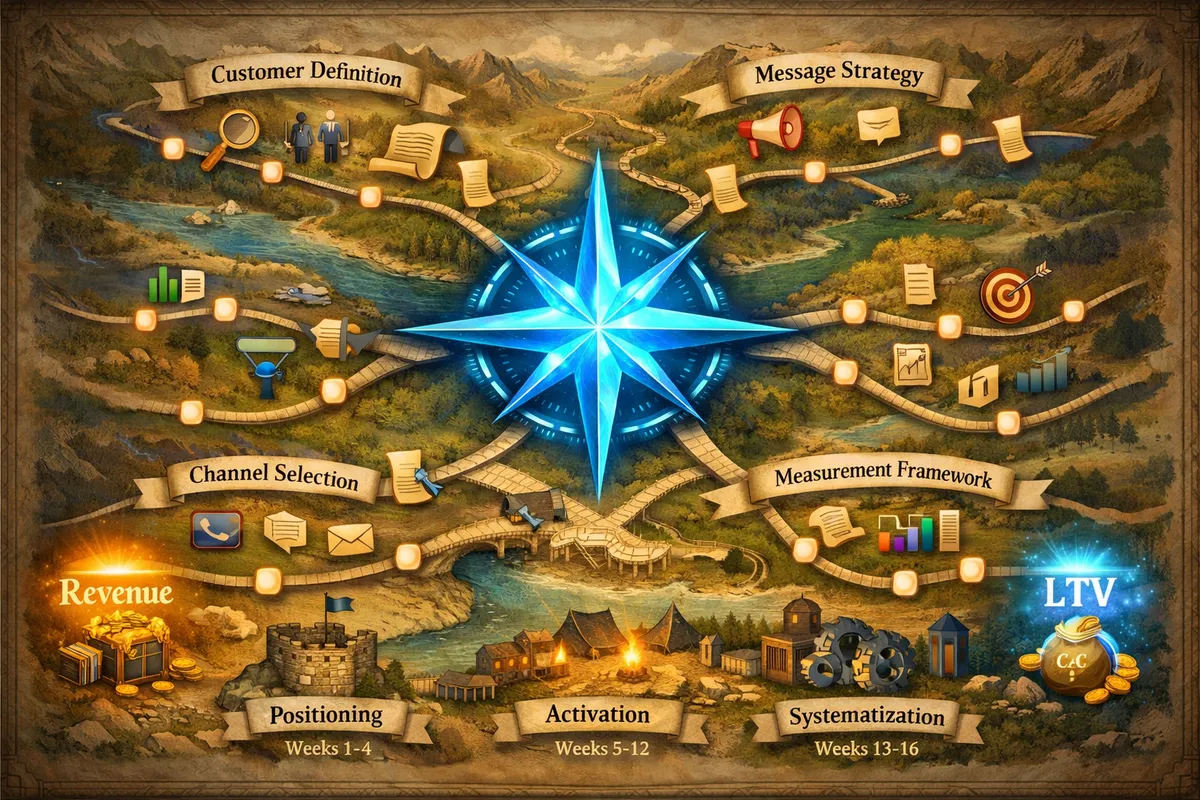
The Atlanta Startup Buying Committee
Atlanta's startup ecosystem includes multiple decision-making personas. Understanding who buys in Atlanta is the foundation of any useful marketing plan.
A founder at the Atlanta Tech Village makes buying decisions based on peer recommendations and demo quality. They ask other Tech Village founders what they use. They attend community events and evaluate vendors who show up and add value.
An enterprise buyer in Buckhead follows a different process. They want case studies from comparable companies. They need procurement approval. The sales cycle is 60 to 120 days, not 7 days. Your marketing plan needs to reflect that reality.
A small business owner in Decatur cares about price and local reputation. They search Google for solutions near them. They read reviews. They ask their accountant or lawyer for referrals. Your marketing plan for this persona should emphasize local SEO, Google Business Profile optimization, and referral programs.
Local examples matter more than national logos. Case studies from successful Atlanta companies carry more weight here than an MIT case study. Atlanta buyers want to know: does this work for companies like mine, in a market like mine?
Pricing follows Atlanta's reality too. Cost of living and office rents are 30 to 40% below San Francisco. Salaries are lower. Revenue expectations are different. A pricing strategy built for the Bay Area may be wildly misaligned for the Atlanta market.
Our Startup Marketing Plan Framework
We build marketing plans in two phases.
Phase 1: Foundation (2 to 3 weeks). This phase establishes the strategic groundwork.
Ideal customer profile: Who are your best customers? What do they have in common? Where do they congregate in Atlanta? What triggers their buying decision?
Problem statements: What problem does your product solve? How does your target customer describe that problem in their own words? What are they currently using to solve it?
Competitive positioning: Who else serves your target customer in Atlanta? What do they do well? Where are the gaps? How do you win?
Go-to-market channel prioritization: Based on your ICP, competitive landscape, and budget, which two or three channels have the highest probability of producing customers? We rank channels by expected ROI and sequence them by ease of execution.
This phase results in a clear, testable thesis about how to acquire your first 100 paying customers.
Phase 2: Execution and Iteration (ongoing). We activate channels in order: typically content and SEO first (builds authority with zero paid spend), then outbound if B2B, then paid acquisition if unit economics support it.
We measure everything. Conversion rate at each funnel stage. Cost per acquisition by channel. Lifetime value by customer segment. Churn by cohort. We kill what does not work and pour resources into what does.
Weekly check-ins keep the plan alive. A marketing plan that sits in a Google Doc collecting dust is worthless. Our plans live in dashboards and get updated based on real performance data.
Atlanta Resources Most Founders Overlook
Invest Atlanta grants. Invest Atlanta's startup grant programs can partially fund marketing activities. Many founders do not realize these exist or assume they do not qualify. We help you identify applicable programs and incorporate them into your budget.
ATDC mentor network. Georgia Tech's Advanced Technology Development Center provides more than office space. The mentor network includes experienced operators who can stress-test your marketing plan and make introductions to potential customers.
Techstars Demo Day. Techstars Atlanta Demo Days generate press coverage and partnership inbound. If you are a Techstars company, your marketing plan should include a Demo Day strategy that maximizes follow-up from the exposure.
Atlanta Tech Village events. The Tech Village hosts regular speaker events, pitch nights, and networking sessions. These are not just networking opportunities. They are customer acquisition channels. Many B2B startups close their first five to ten customers through relationships built at Tech Village events.
HBCU pipeline. Morehouse, Spelman, and Clark Atlanta University represent a massive talent concentration and customer opportunity that most startup marketing plans ignore entirely. The alumni networks are engaged, loyal, and well-connected. Include them in your plan from day one.
Distribution Channels Unique to Atlanta
Fintech belt. Atlanta's concentration of fintech and payments companies creates B2B buying clusters. A SaaS product selling to financial services has a concentrated customer base within a 10-mile radius of Buckhead. Your marketing plan should map these clusters and build targeted outreach programs for each one.
Midtown tech corridor. The stretch from Georgia Tech through Midtown to Buckhead is dense with tech companies, venture firms, and accelerators. Physical proximity creates opportunity for in-person demos, lunch meetings, and referral relationships that remote competitors cannot replicate.
Entertainment and film. Tyler Perry Studios and Atlanta's film production industry create adjacent market opportunities for startups serving creative professionals, production companies, and entertainment businesses.
Logistics hub. Hartsfield-Jackson is the busiest airport in the world. The logistics and supply chain companies clustered around it represent enterprise customers for B2B startups. Your marketing plan should account for this cluster if your product serves operations, logistics, or supply chain functions.
Ponce City Market ecosystem. Ponce City Market has become more than a food hall. The upper floors house tech companies, venture firms, and creative agencies. The ecosystem within that single building creates a micro-market for B2B startups.
Realistic Timeline and Cost
A solid marketing plan costs $3,000 to $8,000 to develop. It takes 3 to 4 weeks. You get a 12-month roadmap with quarterly milestones, channel-specific KPIs, and budget allocation by activity.
Most startup founders invest less than this in marketing planning. Then they spend $50,000 trying random channels that were never part of a coherent strategy. The plan costs 10% of what you would waste without one.
Execution costs vary by channel. Content and SEO require $2,000 to $5,000 per month in a market like Atlanta. Paid acquisition budgets start at $3,000 per month for meaningful data. Outbound sales requires tools and time worth $1,500 to $3,000 per month. Your plan will include specific budget recommendations for each channel based on your stage and goals.
Why Atlanta Startups Choose Running Start Digital
We know your neighbors. We work with founders across Midtown, Buckhead, West Midtown, and the BeltLine corridor. We understand Atlanta's buying patterns, seasonal cycles, and competitive dynamics. Not coastal assumptions applied to a Southern market.
Speed and scrappiness. Startups do not have time for a six-month strategy process. We deliver a testable plan in weeks, then iterate weekly based on real data. If something is not working, we change it immediately.
Emphasis on revenue. Not vanity metrics. Not impressions or followers. Demo requests. Customers. Retention. Revenue. We align incentives from day one so your success is our success.
Atlanta-native reference network. We connect you with other portfolio companies, press contacts, and potential customers in the Atlanta ecosystem. Your marketing plan includes introductions, not just strategies.
Frequently Asked Questions
Q: How is a startup marketing plan different from a regular marketing plan?
Startup plans prioritize speed and learning over perfection. You do not have 12 months to test a brand awareness campaign. You need to find profitable acquisition channels within 90 days. A startup marketing plan is built for iteration. Expect the plan to change monthly as you learn what works in the Atlanta market.
Q: Do I need a marketing plan if I only have a few customers?
Yes. Especially then. A marketing plan at the early stage is really a customer acquisition plan. It documents what you know about your customers, hypothesizes the best channels to reach more of them, and gives you a framework for measuring results. Without it, you are guessing.
Q: Can I build the marketing plan myself?
You can. Many founders do. The risk is blind spots. You know your product better than anyone, but you may not know which channels work best in the Atlanta market, what your competitors are doing, or how to structure a testing framework. A partner brings outside perspective and market knowledge.
Q: What happens after the plan is delivered?
The plan is the beginning, not the end. We can execute the plan for you, coach your team to execute it, or hand it off entirely. Most Atlanta startups choose some combination: we execute the most technical channels (SEO, paid ads) while the founder handles relationship-driven channels (networking, partnerships).
Q: How often should the marketing plan be updated?
Review monthly. Update quarterly. Major pivots happen when data contradicts assumptions. A marketing plan is a living document. If your plan from January still looks exactly the same in June, something is wrong. Either you are not measuring, or you are not adapting.