ADA Compliance for Startup Websites in Chicago
ADA website compliance for Chicago startups. Meet WCAG 2.1 standards, avoid lawsuits, and make your site accessible to all Chicago users.
What WCAG 2.1 AA Compliance Actually Requires
WCAG 2.1 AA is the standard that courts reference and that most enterprise contracts require. It covers four principles: perceivable, operable, understandable, and robust.
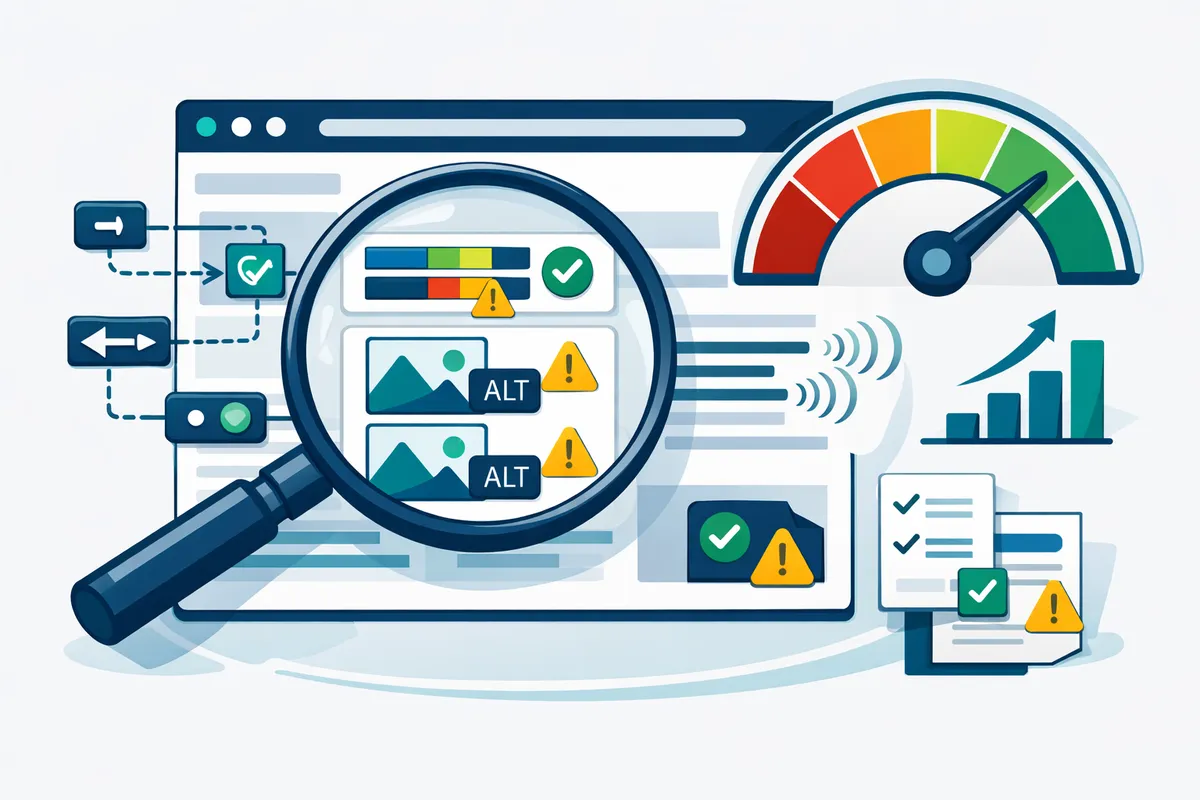
Perceivable. All content must be presentable in ways that users can perceive. This means text alternatives for images (alt text), captions for video and audio content, sufficient color contrast between text and background, and content that works without relying solely on color to convey information.
For Chicago startups, the most common perceivable failures are missing alt text on images, insufficient color contrast in brand colors, and videos without captions. These are all fixable within days.
Operable. All interface components and navigation must be operable by users who cannot use a mouse. This means full keyboard navigation, no keyboard traps, sufficient time for timed content, and no content that causes seizures (flashing elements).
Many Chicago startup websites fail the keyboard navigation test entirely. Try tabbing through your own website. If you cannot reach every link, button, and form field using only a keyboard, your site fails this principle.
Understandable. Content and interface operation must be understandable. This means readable text, predictable page behavior, and input assistance for forms (labels, error messages, suggestions). Forms without proper labels are the most common understandable failure in startup websites.
Robust. Content must be robust enough to be interpreted by a wide variety of user agents, including assistive technologies like screen readers. This means proper HTML structure, valid markup, and appropriate ARIA attributes where native HTML falls short.
Common Accessibility Problems in Chicago Startup Websites
We have audited startup websites across the Loop, River North, West Loop, and Fulton Market. These are the problems we find most frequently.
Missing alt text. Every image needs descriptive alt text that conveys the image's purpose. Decorative images need empty alt attributes so screen readers skip them. Most startup websites have 50 to 80% of images without any alt text at all.
Color contrast failures. Startup brand colors often prioritize aesthetics over accessibility. Light gray text on white backgrounds, colored text on colored backgrounds, and small text with insufficient contrast ratios. WCAG 2.1 AA requires a minimum contrast ratio of 4.5:1 for normal text and 3:1 for large text. We test every color combination on your site and provide accessible alternatives that maintain your brand identity.
Forms without labels. Contact forms, signup forms, and search fields frequently lack proper labels. Placeholder text is not a substitute for labels because it disappears when users start typing. Screen reader users encounter unlabeled form fields and cannot determine what information is expected.
Missing heading hierarchy. Pages that skip heading levels (jumping from H1 to H3, for example) or use headings for visual styling rather than structure confuse screen readers that navigate by heading. Proper heading hierarchy is both an accessibility requirement and an SEO best practice.
Missing skip navigation. Users who navigate by keyboard must tab through every navigation link before reaching the main content on each page load. A skip navigation link lets keyboard users jump directly to the main content. Most startup websites lack this entirely.
Non-descriptive link text. Links that say "click here" or "learn more" provide no context when read out of context by screen readers. Link text should describe where the link goes.
Building Accessible Websites from the Start
When we design or redesign websites for Chicago startups, accessibility is built into the foundation. This approach costs significantly less than retrofitting an inaccessible site.
Component library with built-in accessibility. Every UI component includes proper ARIA labels, keyboard handlers, focus management, and screen reader announcements. Buttons, modals, dropdowns, tabs, and accordions all follow WAI-ARIA authoring practices.
Color palette testing. We test every color combination in your brand palette against WCAG contrast requirements before finalizing the design. If your brand colors fail contrast checks, we identify accessible alternatives that stay true to your brand identity.
Keyboard navigation. Every interactive element is reachable and operable by keyboard. Focus indicators are visible and styled to match your brand. Tab order follows a logical sequence that matches the visual layout.
Semantic HTML. We use native HTML elements for their intended purposes: buttons for actions, links for navigation, headings for structure, lists for grouped items. This gives assistive technologies the information they need without relying on ARIA workarounds.
Automated and manual testing. Automated tools catch approximately 30 to 40% of accessibility issues. The rest require manual testing with screen readers, keyboard-only navigation, and human judgment. We perform both types of testing on every page.
The Accessibility Audit Process
For existing Chicago startup websites, we follow a structured remediation process.
Step 1: Automated scan (Day 1). We run your site through automated testing tools that identify WCAG violations, categorize them by severity, and produce a detailed report. This catches the low-hanging fruit: missing alt text, contrast failures, missing labels, and structural issues.
Step 2: Manual audit (Days 2 to 5). We manually test your site using screen readers (NVDA, VoiceOver), keyboard-only navigation, and other assistive technologies. We test on desktop and mobile. We identify issues that automated tools miss: logical tab order, meaningful link text, proper focus management, and content that only makes sense visually.
Step 3: Prioritized remediation plan. We rank all issues by severity (critical, serious, moderate, minor) and effort to fix. Critical issues (keyboard traps, missing form labels on primary conversion forms) get fixed first. Moderate issues follow. Minor issues are addressed in the next development cycle.
Step 4: Remediation. We fix issues in priority order, testing each fix to confirm it resolves the violation without introducing new ones. Most Chicago startup websites reach WCAG 2.1 AA compliance within 2 to 4 weeks of starting remediation.
Step 5: Accessibility statement and ongoing monitoring. We create an accessibility statement for your website that documents your commitment and provides a contact method for users who encounter barriers. We set up ongoing monitoring to catch regressions when new content or features are added.
Beyond Compliance: Accessibility as a Business Advantage
Accessibility is not just about avoiding lawsuits. It creates measurable business value for Chicago startups.
Expanded market. 26% of American adults have some form of disability. Making your website accessible means your product is available to more potential customers. In a market as large as Chicago, that represents hundreds of thousands of additional users.
Better SEO. Many accessibility practices directly improve search engine optimization. Alt text helps Google understand images. Heading structure helps Google parse content. Semantic HTML helps Google index your pages correctly. Accessible websites consistently rank better in search results.
Improved usability for everyone. Accessibility improvements benefit all users. Captions help people watching video in noisy environments. High contrast helps people using devices in bright sunlight. Keyboard navigation helps power users who prefer not to use a mouse. Clear labels help everyone fill out forms correctly.
Enterprise sales readiness. Large companies in the Loop and along LaSalle Street increasingly require vendors to demonstrate accessibility compliance. Having WCAG 2.1 AA compliance makes your startup ready for enterprise procurement processes that competitors without compliance cannot enter.
Frequently Asked Questions
Q: How much does ADA compliance cost for a Chicago startup website?
An accessibility audit costs $1,500 to $3,000 depending on site size. Remediation costs $2,000 to $8,000 depending on the number and severity of issues. Building a new accessible website costs 10 to 15% more than building a non-accessible one. The total investment is consistently less than the cost of a single demand letter or lawsuit.
Q: Do accessibility overlays work?
No. Overlay widgets that claim to make your site accessible with a single line of JavaScript do not achieve WCAG compliance. They often make the experience worse for assistive technology users. Courts have ruled that overlays do not constitute compliance. We do not recommend or use overlay products.
Q: How often should we test for accessibility?
Test after every major content addition or feature release. Run automated scans monthly. Conduct a full manual audit annually or after significant redesigns. Accessibility is not a one-time project. It requires ongoing attention as your site evolves.
Q: Can we make our site accessible without redesigning it?
Usually yes. Most accessibility issues are fixable without visual design changes. Adding alt text, fixing color contrast, adding proper form labels, and implementing keyboard navigation can all be done within your existing design. A full redesign is only necessary if the fundamental structure or layout creates barriers that cannot be resolved with targeted fixes.
Q: Is ADA compliance required for websites in Illinois?
While the ADA does not explicitly mention websites, courts have consistently applied Title III requirements to websites, particularly for businesses that serve the public. The DOJ has indicated that websites must be accessible. Illinois law adds additional accessibility obligations. Treating website accessibility as required is both legally prudent and the right thing to do.
Q: What about mobile app accessibility?
Mobile apps face the same accessibility requirements as websites. iOS and Android both have built-in accessibility features (VoiceOver, TalkBack) that your app should support. If you have a mobile app, include it in your accessibility audit and remediation plan.
Make Your Chicago Startup Accessible
Accessibility is not a checkbox. It is a design principle that makes your product available to everyone in Chicago. Whether you are building from scratch in the West Loop or remediating an existing site from your Wicker Park office, we make compliance practical, affordable, and permanent.
Ready to put this into action?
We help businesses implement the strategies in these guides. Talk to our team.