Amazon Selling for New Brands in Chicago
Launch your Chicago-based brand on Amazon. Product listing optimization, PPC management, and brand building for Chicago entrepreneurs and startups.
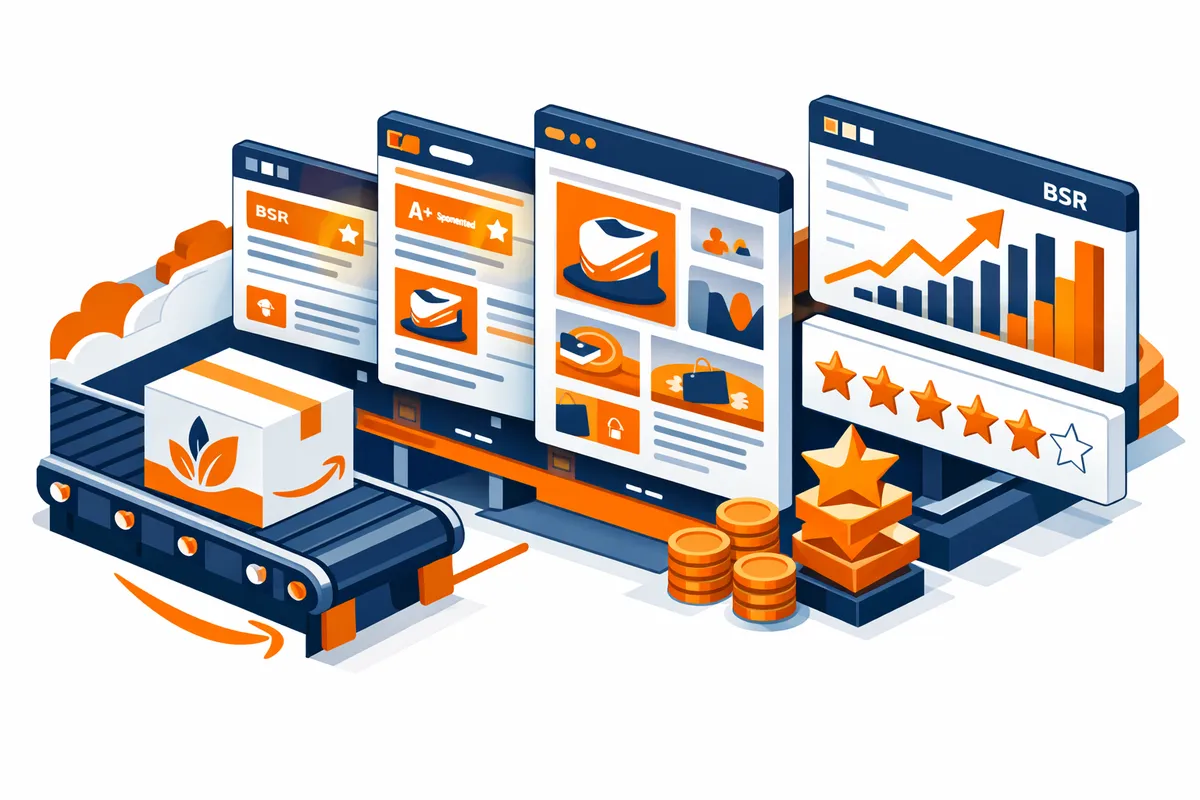
Amazon Listing Optimization for Chicago Sellers
Your product listing is your storefront on Amazon. Every element either converts browsers into buyers or sends them to a competitor. We optimize every piece.
Product titles. Amazon titles follow a specific formula: Brand Name + Key Feature + Product Type + Size/Quantity + Differentiator. Most new sellers either keyword-stuff their titles (which Amazon penalizes) or write titles too short to capture relevant searches. We research the keywords that Amazon shoppers actually use in your category and craft titles that rank for high-volume searches while reading naturally.
Bullet points. Five bullet points. Five opportunities to address the customer's top concerns and differentiate your product. We structure bullets around the benefits customers care about most, not the features you are proud of. The difference matters: "Made with premium materials" is a feature. "Lasts 3x longer than standard alternatives so you buy less often" is a benefit.
Product descriptions. The description expands on your bullets with storytelling and additional detail. For brands enrolled in Brand Registry, A+ Content replaces the basic description with a visual, magazine-style layout that increases conversion rates by 3 to 10% on average.
Backend keywords. Amazon provides hidden keyword fields that influence search ranking without appearing in your listing. We fill these with relevant terms that did not fit naturally in your title and bullets: misspellings customers commonly make, related terms, and long-tail variations.
Images. Amazon allows 7 to 9 images depending on category. The main image must be on a white background. Supporting images should show the product in use, highlight key features, compare to alternatives, display dimensions, and include lifestyle context. For Chicago brands, we often include imagery that subtly signals local origin and quality craftsmanship.
Amazon PPC Strategy for New Brands
Advertising is not optional for new brands on Amazon. Without advertising, your product sits on page 15 of search results where nobody scrolls. PPC (pay-per-click) advertising puts your product in front of shoppers searching for exactly what you sell.
Launch phase (Weeks 1 to 4). The goal is generating initial sales velocity and reviews, not profitability. We run aggressive Sponsored Products campaigns targeting your highest-intent keywords. We also target competitor products with Sponsored Products campaigns that show your listing on their product pages. Advertising Cost of Sales (ACoS) during launch typically runs 30 to 50% because you are investing in ranking momentum.
Optimization phase (Weeks 5 to 12). With initial sales and data, we optimize campaigns for profitability. We cut keywords that convert poorly, increase bids on keywords that convert efficiently, and add negative keywords to prevent wasted spend. ACoS typically drops to 15 to 25% as campaigns mature.
Scale phase (Month 4 and beyond). Profitable campaigns get increased budget. We expand to Sponsored Brands campaigns (showing your logo and multiple products at the top of search results) and Sponsored Display campaigns (retargeting shoppers who viewed your product but did not purchase). The goal is maintaining profitable ACoS while increasing total sales volume.
Budget guidance for Chicago brands. We recommend starting with $1,500 to $3,000 per month in ad spend for a single product launch. This provides enough data to optimize effectively within 60 days. Brands launching multiple products simultaneously should budget $1,000 to $2,000 per product per month.
Amazon Brand Building
Brand Registry is non-negotiable for serious Amazon sellers. It unlocks tools that generic sellers cannot access and protects your brand from counterfeiters and unauthorized resellers.
Brand Registry setup. You need a registered trademark to enroll. If you do not have one, start the application immediately. The trademark process takes 8 to 12 months, but you can enroll in Amazon's IP Accelerator program to get Brand Registry access within weeks while your trademark processes.
A+ Content. Enhanced product descriptions with custom layouts, comparison charts, brand story modules, and rich imagery. A+ Content increases conversion rates and gives your listing a professional appearance that builds trust with shoppers.
Amazon Storefront. Your own branded mini-website within Amazon. Multiple pages, curated collections, brand story, and a custom URL. Storefronts give returning customers a browsing experience and serve as the landing page for your Sponsored Brands campaigns.
Amazon Posts. Instagram-like content that appears in your product listing and category feeds. Free to use. Posts keep your brand visible to shoppers browsing your category and drive discovery of your product catalog.
Common Mistakes Chicago Brands Make on Amazon
Launching without reviews. A product with zero reviews competes against products with hundreds of reviews. Use Amazon's Vine program to get initial reviews from verified reviewers before investing heavily in advertising.
Ignoring negative reviews. Negative reviews contain your most valuable customer feedback. They tell you exactly what to fix in your product, listing, or packaging. Respond to every negative review professionally and use the feedback to improve.
Pricing too high or too low. Chicago brands often price based on their cost structure without researching competitor pricing on Amazon. If comparable products sell for $19.99 and you list at $34.99, no amount of optimization will overcome the price gap. Conversely, pricing too low signals low quality and attracts price-sensitive customers who leave negative reviews.
Underinvesting in images. Professional product photography is the highest-ROI investment for Amazon listings. The difference between smartphone photos and professional images can double your conversion rate. Invest $300 to $1,000 in product photography before spending anything on advertising.
Running out of inventory. Amazon penalizes listings that go out of stock by dropping their organic ranking. Rebuilding that ranking costs more than maintaining adequate inventory. Track sell-through rates and reorder with enough lead time to prevent stockouts.
Fulfillment Strategy for Chicago Sellers
FBA (Fulfillment by Amazon). Amazon stores, picks, packs, and ships your products. Your listings get the Prime badge, which dramatically increases conversion rates. FBA is the right choice for most Chicago brands because Prime eligibility is a major competitive advantage.
Chicago's central location means lower inbound shipping costs to Amazon's fulfillment centers compared to coastal sellers. This is a real margin advantage that compounds with volume.
FBM (Fulfillment by Merchant). You handle your own shipping. This makes sense for oversized items, products with low margins where FBA fees eat profits, or brands that need custom packaging and inserts. Chicago has a strong network of 3PL (third-party logistics) providers that can handle FBM fulfillment professionally.
Hybrid approach. Some Chicago brands use FBA for their best sellers (ensuring Prime eligibility on high-volume items) and FBM for slow-moving or oversized products. We help you determine the optimal fulfillment strategy for each product in your catalog.
Frequently Asked Questions
Q: How much does it cost to launch a new brand on Amazon?
Total launch investment for a single product typically runs $5,000 to $15,000: product photography ($300 to $1,000), listing optimization ($1,000 to $2,000), initial inventory ($2,000 to $5,000), advertising budget for first 90 days ($4,500 to $9,000), and management ($1,500 to $3,000). Returns depend on your product category, pricing, and competitive landscape.
Q: How long before a new Amazon product becomes profitable?
Most new products reach profitability within 3 to 6 months. The first 60 to 90 days typically run at a loss because advertising spend is high relative to sales volume. As organic ranking improves and advertising efficiency increases, margins improve. Products with strong reviews and good unit economics often reach breakeven in month 3 or 4.
Q: Do I need a trademark to sell on Amazon?
No. You can sell on Amazon without a trademark. But Brand Registry, which requires a trademark, unlocks essential tools (A+ Content, Amazon Storefront, brand protection) that significantly improve your competitiveness. Start the trademark process immediately when you decide to sell on Amazon.
Q: Can I sell on Amazon and my own website?
Yes. Many successful Chicago brands sell on both Amazon and their own Shopify or WooCommerce store. Amazon provides volume and discovery. Your own website provides higher margins and direct customer relationships. The strategies complement each other.
Q: Should I use an Amazon agency or manage it myself?
If you have the time to learn Amazon's systems and manage campaigns daily, self-management is viable. Most Chicago entrepreneurs find that the learning curve is steep and the time investment competes with other business priorities. An agency or consultant who specializes in Amazon can accelerate your results and free your time for product development and business strategy.
Launch Your Chicago Brand on Amazon
Amazon rewards brands that launch with strategy, optimize relentlessly, and build for the long term. Whether you are a product designer in Fulton Market, a food brand in Pilsen, or a consumer goods startup at 1871, the path from idea to profitable Amazon sales follows the same proven framework.
Ready to put this into action?
We help businesses implement the strategies in these guides. Talk to our team.