Custom Software vs Off-the-Shelf for Chicago Businesses
Should your Chicago business build custom software or buy off-the-shelf? Cost comparison, timeline analysis, and strategic guidance for Chicago companies.
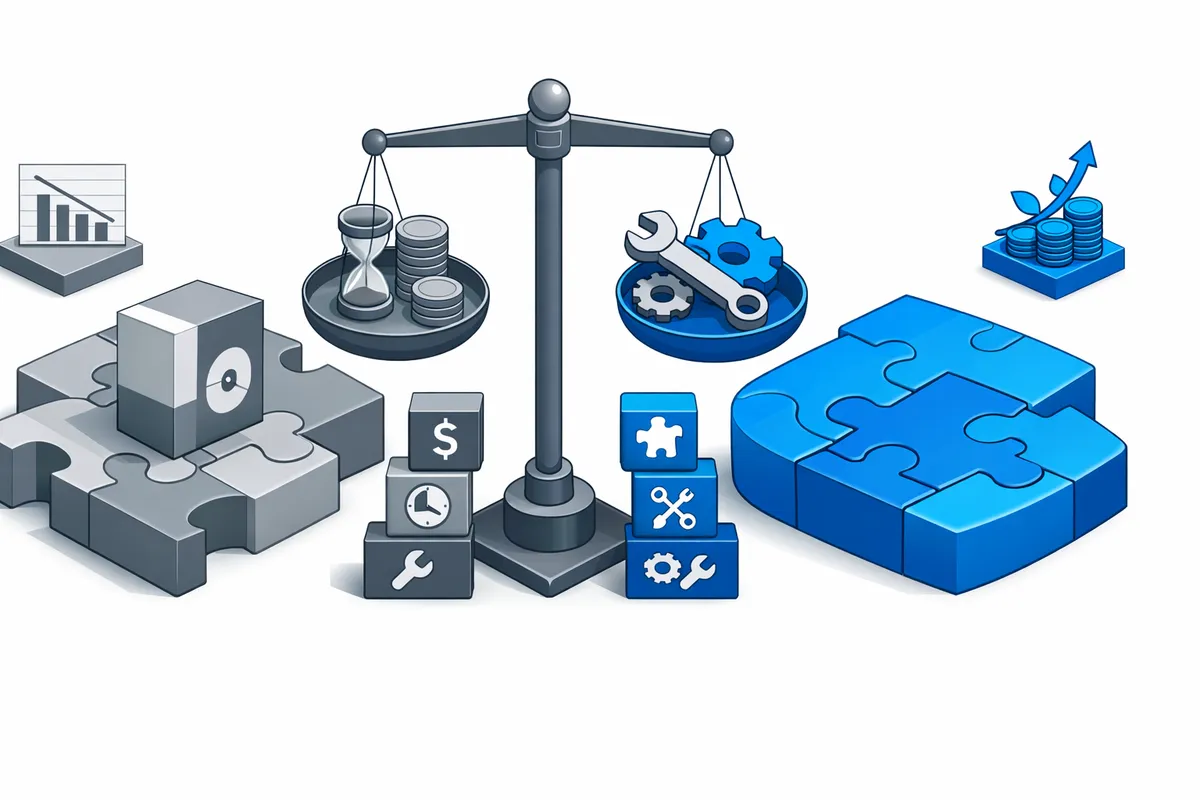
When Custom Software Wins in Chicago
Chicago's business landscape creates specific scenarios where custom development delivers clear ROI.
Logistics and supply chain operations. Chicago is the freight capital of North America. Companies moving goods through O'Hare, the rail yards, and Chicagoland distribution centers have routing, scheduling, and compliance requirements that no generic logistics platform fully addresses. A West Loop logistics startup built custom dispatch software that reduced route planning time by 60%. Off-the-shelf tools could not handle their intermodal requirements.
Financial services workflows. LaSalle Street and the financial district run on proprietary processes. Trading firms, insurance companies, and fintech startups along the river have compliance requirements and workflow patterns that generic software cannot match. When your edge is your process, standardizing on someone else's tool eliminates your advantage.
Healthcare and biotech operations. The Illinois Medical District and Northwestern's innovation hub generate companies with regulatory requirements that off-the-shelf software handles poorly. HIPAA compliance, clinical trial management, and patient data workflows need purpose-built systems.
Multi-location service businesses. Chicago companies operating across Chicagoland neighborhoods face location-specific regulations, pricing, and staffing patterns. A home services company operating in Lincoln Park, Pilsen, and the North Shore needs scheduling and dispatching logic that accounts for geographic complexity.
When Off-the-Shelf Wins
Not everything needs custom development. Standard business functions are commodities. Building custom solutions for them wastes money and time.
Accounting and bookkeeping. QuickBooks or Xero. Your accounting is not a competitive advantage. Do not build custom.
Email and communication. Google Workspace or Microsoft 365. There is no reason to build email infrastructure.
Project management. Linear, Asana, or Monday. Your project management process is not unique enough to justify custom tooling unless you have 50+ people with highly specialized workflows.
Basic CRM. HubSpot or Salesforce for standard sales processes. Custom CRM makes sense only when your sales process is fundamentally different from what these platforms support.
Payment processing. Stripe or Square. Never build payment infrastructure unless you are a fintech company.
The rule is simple. If the process is a competitive advantage, build custom. If it is a cost of doing business, buy off-the-shelf.
The Hybrid Approach: What Most Chicago Businesses Actually Need
The build-versus-buy framing is a false binary. Most successful Chicago tech companies use a hybrid approach. They buy commodity software for standard functions and build custom for their competitive edges.
A Fulton Market food tech company might use Shopify for their storefront, QuickBooks for accounting, and Slack for communication. But they build custom software for their proprietary supply chain optimization, recipe scaling algorithms, and vendor management workflows.
The hybrid approach looks like this:
1. List every software need. Inventory every process that requires technology. 2. Classify each as commodity or differentiator. If your competitors use the same process, it is a commodity. If it creates your competitive edge, it is a differentiator. 3. Buy commodity. Build differentiators. Use off-the-shelf for 70-80% of needs. Build custom for the 20-30% that matters. 4. Connect everything. APIs and integrations tie your custom software to your off-the-shelf tools. This is where many Chicago businesses need help.
Chicago's Development Advantage
Building custom software in Chicago costs less than coastal markets. Senior developers in the Loop command $140,000 to $180,000 annually, compared to $200,000 to $280,000 in San Francisco. Contract development rates run $120 to $200 per hour in Chicago versus $180 to $300 on the coasts.
The talent pool is deep. Northwestern, University of Chicago, Illinois Tech, DePaul, and UIC produce thousands of computer science graduates annually. 1871 and Techstars Chicago create a steady pipeline of technical talent with startup experience. The result is that custom development projects that would cost $150,000 in San Francisco cost $80,000 to $120,000 in Chicago.
This cost advantage changes the build-versus-buy math. Projects that would be financially impractical in New York or San Francisco become viable in Chicago. The breakeven point where custom software pays for itself arrives sooner.
The Decision Framework
Use this framework to evaluate each technology decision:
Build custom when: - The process creates competitive advantage - Off-the-shelf tools require more than 3 significant workarounds - You need the same data flowing through multiple systems in real time - Vendor lock-in threatens your business model - Your team spends more than 10 hours per week working around software limitations
Buy off-the-shelf when: - The process is standard across your industry - A market-leading product covers 80%+ of your requirements - The learning curve for custom development exceeds the benefit - You need the solution operational within 2 weeks - The total three-year cost of off-the-shelf is less than half the custom estimate
Consider hybrid when: - You need custom logic connected to standard platforms - Your competitive edge lives in one specific workflow - You want to build incrementally, replacing off-the-shelf components over time
How Running Start Digital Approaches Build vs Buy
We do not default to building. Building means revenue for us, but we recommend it only when the analysis supports it. Many Chicago businesses come to us wanting custom software and leave with a recommendation to buy an off-the-shelf tool plus light customization. Others come wanting a SaaS recommendation and leave with a case for building.
Our process starts with a technology assessment. We map your workflows, identify your differentiators, calculate three-year costs for both paths, and deliver a recommendation with transparent reasoning. If you should buy, we help you evaluate and implement. If you should build, we scope and develop.
Frequently Asked Questions
Q: How long does custom software development take in Chicago?
Most custom business applications take 8 to 16 weeks from design to launch. Simple internal tools can be built in 4 to 6 weeks. Complex platforms with multiple integrations may take 16 to 24 weeks. Chicago's deep developer pool means you can staff projects quickly without waiting months to find qualified talent.
Q: What happens if my off-the-shelf vendor raises prices or shuts down?
This is the core risk of buying. You have no control over pricing changes, feature removals, or vendor bankruptcy. Mitigation strategies include maintaining data exports, documenting processes independent of tools, and choosing vendors with strong financials. Custom software eliminates this risk entirely because you own the code.
Q: Can I start with off-the-shelf and switch to custom later?
Yes, and this is often the smartest approach for early-stage Chicago startups. Use off-the-shelf tools to validate your business model and understand your actual requirements. Once you know exactly what you need, build custom to replace the components where off-the-shelf falls short. The learning from using off-the-shelf tools makes your custom build more focused and efficient.
Q: Should I hire developers or use an agency for custom development?
For your first custom project, an agency is typically better. You get a team with experience delivering complete applications, and you avoid the overhead of hiring, managing, and retaining developers. Once you have ongoing custom software needs requiring 40+ hours of development per week, an in-house team becomes more cost-effective. Many Chicago companies use agencies like Running Start Digital for the initial build and then bring development in-house for ongoing iteration.
Q: What tech stack should custom software use?
The right stack depends on your application type, team capabilities, and long-term plans. For most Chicago startups building web applications, we recommend Next.js with PostgreSQL. It is fast, scalable, well-supported, and easy to hire for in the Chicago market. For mobile applications, React Native provides cross-platform development. For data-intensive applications, Python with appropriate frameworks. We always choose technologies with strong Chicago developer communities so you can hire locally for maintenance and growth.
Q: How do I evaluate whether my current software is holding my business back?
Three signals. First, your team spends more than 10 hours per week on manual workarounds. Second, you have turned down business or delayed launches because your tools could not support the work. Third, you are paying for three or more tools that partially overlap because none of them fully solves your problem. If two or more of these apply, a technology assessment will clarify whether custom development would create positive ROI.
Ready to put this into action?
We help businesses implement the strategies in these guides. Talk to our team.