Lead Generation for B2B Startups in Chicago
Build a B2B lead generation engine for your Chicago startup. Inbound funnels, outbound prospecting, and conversion optimization in the Chicago market.
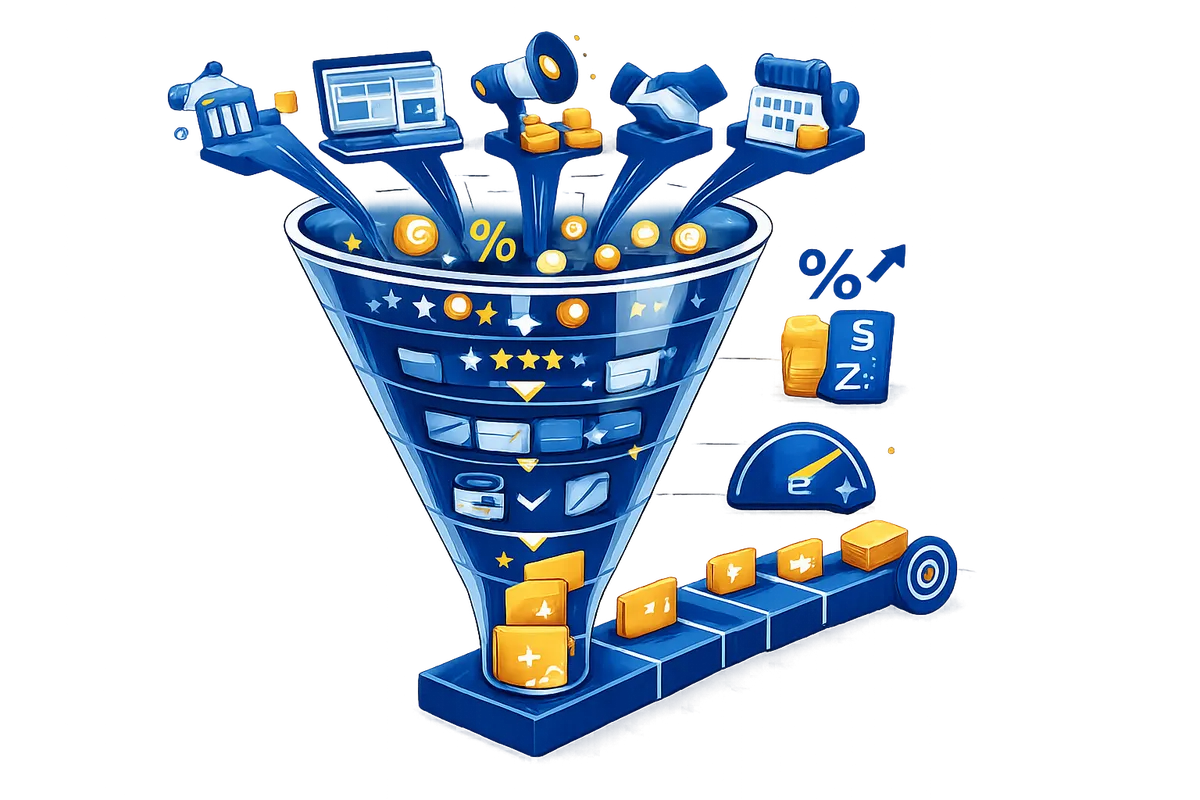
The Three-Channel Lead Generation System
B2B lead generation works best when three channels operate simultaneously: inbound content, outbound prospecting, and referral systems. Each channel feeds the others. Inbound content warms cold prospects before outbound hits their inbox. Outbound conversations generate content ideas. Referrals come from customers acquired through both channels.
Channel 1: Inbound Content and SEO
Goal: Generate 20 to 50 inbound leads per month within 6 months.
Inbound lead generation starts with content that answers the questions your target customers are actively searching. A Loop CFO searching "best accounting software for mid-market companies" is telling you exactly what they need. If your content appears in that search result, you win the first impression.
The inbound content stack:
Blog posts targeting buying-intent keywords. Not thought leadership fluff. Posts that address specific problems your product solves. "How to automate accounts payable for Chicago mid-market companies" will generate more leads than "The future of fintech in 2026."
Landing pages for each use case. Your homepage cannot serve every buyer persona. A CFO looking for AP automation needs a different page than a CTO evaluating integration platforms. Each landing page speaks directly to one buyer's problem, in their language, with Chicago-specific context.
Gated resources for lead capture. Guides, templates, checklists, and tools that provide genuine value. Your prospect gives you their email in exchange for something useful. A guide to "Selecting a Logistics Management Platform for Chicagoland Operations" captures exactly the audience a logistics SaaS company wants to reach.
Email nurture sequences. Not every lead is ready to buy today. Nurture sequences deliver value over 4 to 8 weeks, building trust until the prospect is ready to have a conversation. A well-built nurture sequence converts 15-25% of leads to sales conversations over time.
Expected timeline: Inbound content takes 3 to 6 months to generate consistent leads. By month 6, a well-executed content strategy generates 20 to 50 leads per month at a cost of $50 to $150 per lead. By month 12, that drops to $30 to $80 per lead as content compounds.
Channel 2: Outbound Prospecting
Goal: Generate 10 to 20 qualified meetings per month starting in month 1.
Outbound prospecting generates immediate pipeline while inbound content builds momentum. Chicago's B2B density makes outbound particularly effective because your messaging can reference local context that captures attention.
Building your prospect list:
Start with your ideal customer profile. Industry, company size, revenue range, technology stack, decision-maker titles. Then filter for Chicago metro geography.
Data sources for Chicago prospect lists: LinkedIn Sales Navigator filtered to Chicago metro area, industry association member directories, 1871 and Techstars Chicago company directories, local business journals and award lists, event attendee lists from Chicago tech conferences.
A targeted list of 500 to 1,000 Chicago companies matching your ICP gives you 3 to 6 months of prospecting pipeline.
Multi-channel outreach sequences:
Cold outreach works when it is relevant, personal, and persistent. The sequence combines LinkedIn and email across 4 to 6 touches over 3 weeks.
Touch 1 (Day 1): LinkedIn connection request. A short note referencing something specific about the prospect or their company. Not "I'd love to connect." Something like referencing their recent talk at an industry event or their company's expansion into a new market.
Touch 2 (Day 3): Email. A 3-sentence email addressing a specific problem relevant to their role and industry. No attachments. No case studies. Just the problem and a question.
Touch 3 (Day 7): LinkedIn message. A follow-up with a relevant insight or resource. Not "Just following up" but genuine value.
Touch 4 (Day 10): Email. A brief case study or data point showing results with a similar Chicago company.
Touch 5 (Day 14): LinkedIn or email. A break-up message. "If this isn't relevant, no worries. But if timing is the issue, happy to reconnect in Q3."
Expected results: Well-targeted outbound to Chicago B2B prospects generates response rates of 8-15%. Of those responses, 30-50% convert to meetings. A sequence of 100 prospects per month should generate 8 to 15 responses and 3 to 7 meetings.
Channel 3: Referral and Partner Systems
Goal: Generate 5 to 15 referral leads per month within 6 months.
Referrals are the highest-converting lead source. Referred prospects close at 2 to 3 times the rate of cold prospects and have 25% higher lifetime value. But most Chicago startups treat referrals as a passive channel. They hope customers refer. They do not build systems.
Structured referral program components:
- Clear ask. Tell customers exactly what type of referral you want. "Do you know any logistics managers at Chicagoland distribution companies?" is better than "Know anyone who might need our product?"
- Timing. Ask for referrals 30 to 60 days after onboarding, when the customer has experienced value but the relationship is still fresh.
- Incentives. Discounts, credits, or cash bonuses for successful referrals. $500 per closed referral is standard for B2B SaaS. The cost is negligible compared to the value of a qualified lead.
- Partner programs. Chicago's ecosystem creates natural partnership opportunities. 1871 companies partner with each other. Consulting firms refer technology providers. Agencies refer complementary service providers. Formalize these relationships with mutual referral agreements.
Converting Leads to Pipeline
Generating leads is half the battle. Converting leads to qualified pipeline requires a sales process that matches how Chicago B2B buyers make decisions.
Lead qualification framework:
Not every lead is worth pursuing. Qualify leads before investing sales time.
- Budget. Can they afford your solution? If your product costs $2,000/month and they are looking for a $200/month tool, they are not qualified.
- Authority. Are you talking to a decision maker? If not, can they introduce you to one?
- Need. Do they have the problem your product solves? A lead who downloaded a guide but does not have the problem is not qualified.
- Timeline. When do they need a solution? A prospect buying in Q4 is not worth daily follow-up in Q1.
Speed to response. Chicago B2B buyers expect fast responses. Leads that receive a response within 5 minutes are 100 times more likely to convert than leads contacted after 30 minutes. Set up automated response systems for inbound leads and dedicate a team member to responding to outbound replies within 2 hours.
Discovery meeting structure. Your first meeting is not a demo. It is a diagnostic conversation. Understand their problem before presenting your solution. Ask about current processes, pain points, costs of the problem, and what they have tried. Chicago buyers respect consultative selling over pitch-driven approaches.
Lead Generation Metrics and Benchmarks
Track these metrics weekly. If the numbers are not moving in the right direction, change your approach.
| Metric | Healthy Benchmark | Warning Sign |
|---|---|---|
| Website visitors to leads | 2-5% | Below 1% |
| Leads to qualified opportunities | 15-25% | Below 10% |
| Qualified opportunities to closed deals | 20-35% | Below 15% |
| Outbound response rate | 8-15% | Below 5% |
| Average deal cycle (days) | 30-90 | Over 120 |
| Cost per lead (inbound) | $50-$150 | Over $200 |
| Cost per lead (outbound) | $100-$250 | Over $400 |
| Cost per qualified meeting | $200-$500 | Over $800 |
Frequently Asked Questions
Q: How long does it take to build a lead generation system?
Outbound prospecting produces first meetings within 2 to 4 weeks. Inbound content generates consistent leads within 3 to 6 months. A full three-channel system hitting its stride takes 6 to 9 months. Most Chicago B2B startups see positive ROI by month 4 when outbound and early inbound start compounding.
Q: What budget do I need for B2B lead generation?
Minimum viable lead generation runs $3,000 to $5,000 per month. This covers content production, LinkedIn Sales Navigator, email tools, and basic paid amplification. At $5,000 to $8,000 per month, you can run all three channels with meaningful volume. Most Chicago B2B startups allocate 10-15% of target revenue to lead generation in growth mode.
Q: Should I hire an in-house SDR or outsource lead generation?
Hire in-house when you need 40+ hours per week of dedicated prospecting and have the management bandwidth to train and develop an SDR. Outsource when you need lead generation expertise without the hiring commitment, or when you are still defining your ideal customer profile and sales process. Many Chicago startups outsource for 6 to 12 months, learn what works, then hire in-house with a proven playbook.
Q: How do I target specific industries in Chicago?
Start with industry association directories, Chicago business journal award lists, and LinkedIn Sales Navigator industry filters. Attend industry-specific events in Chicago. Join relevant groups at 1871 or industry-specific accelerators. Each industry cluster in Chicago has its own networking rhythms. Fintech has LaSalle Street connections. Food tech has Fulton Market and West Loop communities. Healthcare has the Illinois Medical District ecosystem.
Q: What CRM should a Chicago B2B startup use?
HubSpot CRM is the best option for most Chicago startups under $5M in revenue. It is free to start, scales well, and integrates with every tool you will need. If you are selling complex enterprise deals to Loop corporations, Salesforce may be worth the investment. Avoid building custom CRM unless you have a unique sales process that no existing tool supports. Your CRM should be operational within a week, not a project that takes months.
Q: How do I measure if lead generation is working?
Track pipeline value, not vanity metrics. Leads and meetings are inputs. Pipeline value and revenue are outputs. If your lead generation system produces 20 meetings per month but none convert to pipeline, the system is broken. If it produces 8 meetings per month and 5 become qualified pipeline, the system is working. Measure weekly and optimize based on conversion rates at each stage.
Ready to put this into action?
We help businesses implement the strategies in these guides. Talk to our team.