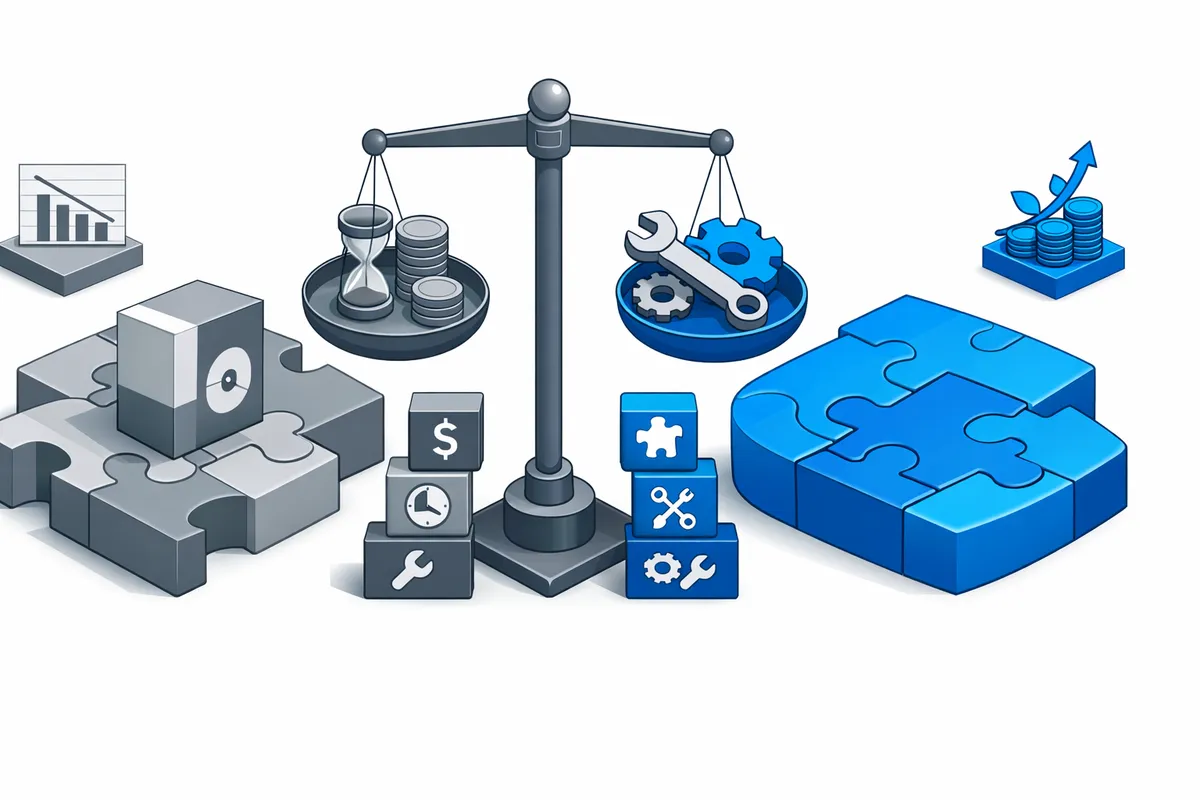
When Off-the-Shelf Is the Right Choice
Off-the-shelf software wins clearly in several scenarios. Recognizing these saves you from spending custom development dollars where they do not create value.
Commodity functions. Accounting, email, calendar, basic project management, word processing, and file storage are commodity functions. QuickBooks, Gmail, Google Calendar, and Dropbox do these things well. Building custom versions of commodity tools wastes money that should go toward your competitive advantages.
Early-stage exploration. If your business is still defining its processes, off-the-shelf tools let you experiment without committing to a custom build. Use Trello until you know your project management process. Use HubSpot's free CRM until you understand your sales pipeline. Then decide whether custom development addresses gaps that matter.
Regulatory compliance. Some functions require certified, audited software. Payroll processing, healthcare records management, and financial reporting have compliance requirements that are easier (and safer) to meet with established platforms that have already been certified. Building custom software for heavily regulated functions means owning the compliance burden entirely.
Network effects. Some tools provide value specifically because many people use them. Slack, LinkedIn, and Zoom derive their utility from network adoption. Building custom alternatives to network-effect platforms rarely makes sense.
When Custom Software Creates Real Advantage
Custom development delivers value when your operations create competitive differentiation that generic tools cannot support.
Unique operational processes. Detroit's automotive corridor produces companies with operational requirements shaped by decades of industry-specific practices. A supplier quality management system for Tier 1 automotive suppliers has requirements that no generic project management tool can address. The inspection workflows, PPAP documentation, and IATF compliance tracking are specific enough that forcing them into generic software creates more problems than it solves.
Data as competitive advantage. If your business collects, processes, or analyzes data in ways that create insight your competitors do not have, custom software protects and enhances that advantage. A Detroit mobility startup that uses proprietary algorithms to optimize fleet routing builds that logic into custom software, not into a Trello board with complex workarounds.
Customer-facing technology. When software is your product or a critical part of your customer experience, custom development is typically the only option. Your customers interact with your technology and judge your business by its quality. A generic platform with your logo on it does not create the experience or functionality that differentiates your offering.
Integration complexity. When your business requires deep integration between multiple systems with custom data flows, building a custom integration layer often makes more sense than maintaining dozens of fragile third-party connectors. A unified system that connects your CRM, inventory, order management, and billing with clean, purpose-built data flows is more reliable and less expensive to maintain than a patchwork of Zapier automations and API middleware.
Scale-specific requirements. Off-the-shelf tools work well at small scale. At high volume, their limitations become expensive. A Detroit e-commerce company processing 10,000 orders per month might outgrow Shopify's standard capabilities and need custom order management, inventory allocation, and fulfillment optimization that the platform cannot provide.
The Detroit Software Decision Landscape
Detroit's market characteristics influence the build-vs-buy decision in specific ways.
Automotive industry specificity. Companies in the automotive supply chain, from Tier 1 suppliers to aftermarket distributors to mobility startups, have operational requirements shaped by the industry's unique standards, timelines, and quality expectations. Generic business software was not designed for automotive program management, APQP workflows, or just-in-time inventory coordination. These are custom software opportunities.
Talent availability. Detroit's deep engineering talent pool, anchored by Wayne State, the Ann Arbor corridor, and the automotive workforce transition, makes custom development more accessible than in many markets. The engineers transitioning from automotive to software bring systems thinking, rigorous testing practices, and experience with complex integration that directly benefit custom software projects.
Cost position. Custom software development in Detroit costs 30 to 50% less than in San Francisco, New York, or Boston. This shifts the break-even point in the build-vs-buy analysis significantly. Projects that would not pencil out at coastal rates can deliver strong ROI at Detroit rates.
Innovation velocity. The pace of change in Detroit's technology ecosystem, driven by Michigan Central, TechTown, and the mobility corridor, means businesses need to adapt quickly. Custom software adapts at the speed of your development cycle. Off-the-shelf software adapts at the speed of the vendor's roadmap, which may not align with your market's pace.
A Framework for Making the Decision
When our clients in the Renaissance Center, New Center, or across the metro face the build-vs-buy decision, we use a structured evaluation.
Step 1: Identify your competitive processes. Which of your business processes create differentiation? Which processes do your competitors also perform essentially the same way? Competitive processes are custom candidates. Commodity processes are off-the-shelf candidates.
Step 2: Calculate total cost of ownership. For the off-the-shelf option: subscription + per-user fees + integration costs + customization costs + training costs + productivity loss from workarounds + manual process costs. For the custom option: development cost + annual maintenance + training costs. Compare over a five-year horizon.
Step 3: Assess flexibility requirements. How likely are your processes to change in the next two to three years? If your business is stable and your processes are established, off-the-shelf tools that fit today will likely fit tomorrow. If your business is evolving rapidly, custom software that adapts with you avoids the cycle of outgrowing tools and migrating to new ones.
Step 4: Evaluate integration requirements. How many systems need to connect? How complex are the data flows? Simple integrations (CRM syncs with email) are well-handled by off-the-shelf tools. Complex integrations (real-time data flow between inventory, manufacturing, shipping, and billing) often justify custom development.
Step 5: Consider the hybrid approach. Most Detroit businesses benefit from a combination. Off-the-shelf for commodity functions. Custom development for competitive functions. Clean integrations between the two. This approach captures the cost efficiency of established platforms while building differentiation where it matters.
The Hybrid Approach in Practice
The best technology strategy for most Detroit businesses is not purely custom or purely off-the-shelf. It is a hybrid that uses each approach where it creates the most value.
Example: Detroit professional services firm. QuickBooks for accounting (commodity). HubSpot for CRM (commodity with some customization). Custom project management application built around the firm's specific client onboarding, project tracking, and deliverable management process (competitive differentiation). Automated integrations between all three systems.
Example: Detroit manufacturing startup. NetSuite for financials (commodity at scale). Custom production planning and quality management application (competitive differentiation). Custom supplier portal (customer-facing technology). API integrations connecting financial, production, and supplier systems.
The hybrid approach lets you invest custom development dollars where they create competitive advantage while using proven platforms for everything else.
FAQs
Q: How do we know when we have outgrown off-the-shelf software?
Three signals. Your team has created workarounds that add more than five hours of manual work per week. You are paying for three or more tools that should be one system. Your operations team spends more time managing software than doing their actual work. Any one of these signals suggests custom development would create value.
Q: Is it risky to build custom software for a small business?
The risk is proportional to how you approach it. Starting with a small, well-defined custom application that addresses your highest-value pain point is low risk and high reward. Attempting to build a comprehensive enterprise system from scratch is high risk. Start small, prove value, and expand.
Q: How long does custom software take to build compared to deploying off-the-shelf?
Off-the-shelf deployment takes one to four weeks for basic setup. Custom development takes eight to twenty weeks for a first version depending on complexity. The time investment is higher, but the productivity gains often exceed what off-the-shelf can provide. The break-even point where custom software's productivity advantage offsets the longer development time is typically four to eight months after launch.
Q: What about ongoing maintenance for custom software?
Plan for annual maintenance costs of 15 to 20% of the initial development cost. This covers bug fixes, security updates, minor feature additions, and infrastructure management. Some years require more (major feature additions). Some years require less (stable operations). This is predictable and typically less than the escalating subscription and integration costs of off-the-shelf alternatives at scale.
Q: Can we start with off-the-shelf and migrate to custom later?
Yes, and this is often the smartest approach. Use off-the-shelf tools to understand your processes and requirements. When you have clear evidence of where generic tools fall short, you have a precise specification for custom development. The data you accumulate in off-the-shelf tools can be migrated to custom systems. We help Detroit businesses plan and execute these transitions.
[Get Your Technology Assessment] [View Detroit Projects]