The Brand Strategy Foundation
Every enduring brand starts with strategic clarity. Before designing anything visual, you need to answer five foundational questions.
1. Who Is Your Customer?
Not "everyone." Not "businesses." A specific person with specific needs, specific frustrations, and specific decision-making criteria. A financial planning startup targeting "anyone who needs financial advice" will build a generic brand. A financial planning startup targeting "tech professionals aged 28 to 40 earning $120,000+ who want to maximize equity compensation" will build a brand that resonates deeply.
For Detroit startups, your customer definition should also consider the local market dynamics. Are you selling to the automotive corridor? To the growing healthcare tech ecosystem around Henry Ford Health? To the creative class in Eastern Market and Brush Park? Each audience responds to different brand signals.
2. What Problem Do You Solve?
Not what your product does. What problem it eliminates. Customers do not buy features. They buy outcomes. Frame the problem in your customer's language. Not technical terms. Not industry jargon. In the words they would use to describe their frustration.
3. Why Should They Choose You?
Your competitive advantage is not a feature list. It is the combination of capabilities, approach, and values that makes you the best option for your specific customer. Identify 2 to 3 genuine differentiators that matter to your customer. These become the pillars of your brand positioning.
4. What Do You Stand For?
Brand values are not wall decorations. They are decision-making frameworks. Choose 3 to 5 values that genuinely guide how your company operates. Not aspirational values you wish you had. Real values that influence daily decisions. Detroit values substance. Your brand values should reflect that.
5. Where Are You Going?
Your brand should reflect not just where you are today but where you are headed. A startup brand that only represents your current product limits your ability to expand. A brand built around your mission and market vision accommodates growth.
Visual Identity: More Than a Logo
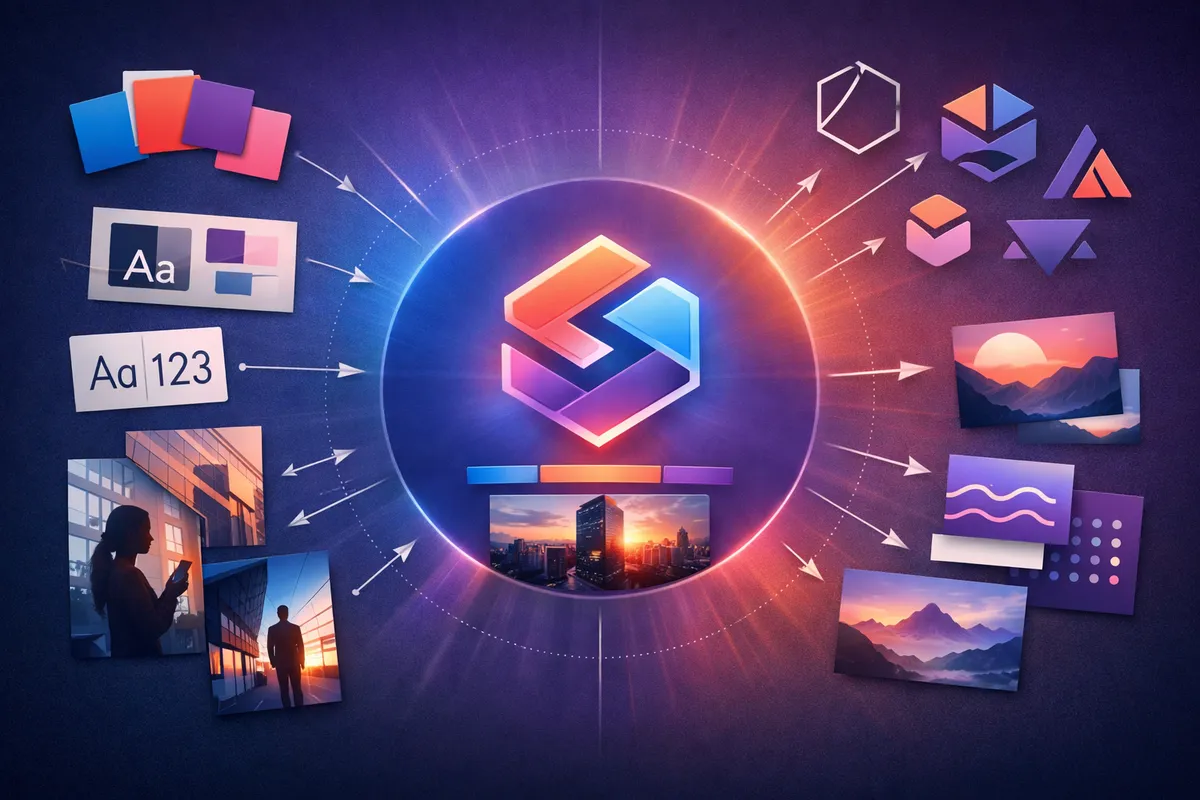
Your visual identity is the system that makes your brand recognizable across every touchpoint.
Logo Design
Your logo is the most visible brand element, but it is not the most important one. A great logo is simple enough to work at 16 pixels (a browser favicon) and distinctive enough to be recognizable at a glance.
Effective startup logos share characteristics: simplicity, versatility across backgrounds and sizes, and a clear connection to the brand's personality. We design logos in multiple formats: full logo with wordmark, icon-only version, horizontal and stacked layouts, single-color versions, and favicon variations.
Color Palette
Colors trigger emotional responses and create recognition. A complete brand color system includes 2 to 3 primary colors, 2 to 3 secondary colors for accents, neutral colors for backgrounds and text, and functional colors for digital product states.
Color choices carry meaning. Blue communicates trust and stability. Orange communicates energy. Green communicates growth. The colors you choose should align with the emotional response you want to trigger. Detroit's industrial aesthetic often inspires bold, grounded palettes, but your brand should reflect your specific identity, not a generic "Detroit look."
Typography
Your typeface selection influences how your brand feels. Serif fonts communicate tradition and authority. Sans-serif fonts communicate modernity and clarity. A complete typography system includes a heading typeface, a body text typeface, and defined sizes, weights, and spacing for consistent application.
Imagery Style
Consistent imagery creates recognition. Define whether your brand uses photography or illustration. If photography, define the style. Many startups default to generic stock photography that communicates nothing. For Detroit startups, incorporating recognizable elements, the Michigan Central building, the Woodward Avenue skyline, Eastern Market murals, builds local connection without being heavy-handed.
Messaging Strategy: What You Say and How You Say It
Visual identity makes your brand recognizable. Messaging makes it persuasive.
Brand Narrative
Your brand narrative is the story of why your company exists, what you believe, and where you are going. It is not a history of your founding. It is a purpose statement that connects with your customer's aspirations.
A strong brand narrative follows a structure: the world has a problem, existing solutions fall short, you saw a better way, and here is the future you are building. For Detroit startups, the city's own narrative of reinvention can amplify yours. Building something new in a city that is rebuilding itself carries resonance.
Value Proposition
Your value proposition is the single clearest statement of what you offer and why it matters. "We help businesses grow" is not a value proposition. "We build automation systems that let startups scale revenue 3x without hiring" is.
Messaging Framework
A messaging framework documents how your brand communicates across different audiences and contexts. It includes your primary tagline, elevator pitch, boilerplate description, key messages for each audience segment, and proof points. This framework ensures consistency whether the message comes from your CEO at a Campus Martius networking event, your marketing team in a blog post, or your sales team in a prospect meeting.
Brand Voice: How You Sound
Your brand voice is the personality that comes through in every written and spoken communication. It is distinct from messaging because it defines how you say things.
Defining Your Voice
Brand voice exists on several spectrums. Are you formal or conversational? Authoritative or collaborative? Technical or accessible? Position your brand based on what your customers expect. A cybersecurity startup should sound authoritative and precise. A consumer wellness brand should sound warm and approachable.
Detroit's culture leans toward directness, substance, and authenticity. The most successful Detroit brands avoid corporate fluff and speak plainly about what they do and why it matters.
Documenting Your Voice
A brand voice guide includes 3 to 5 voice attributes with definitions, examples of each attribute in action, do's and don'ts for common communication types, and sample copy for frequent scenarios. This document becomes the reference that ensures consistency as your team grows.
The Branding Process
Phase 1: Discovery (1 Week)
We research your market, competitors, and target customers. We interview your founding team about vision, values, and goals. We audit any existing brand materials. The output is a strategic brief that guides all creative work.
Phase 2: Strategy (1 Week)
We develop your brand positioning, messaging framework, and voice definition. You review and refine until the strategic foundation feels authentic and compelling.
Phase 3: Visual Identity (2 Weeks)
Logo concepts, color palette, typography selection, and imagery direction. We present 2 to 3 creative directions. You select and refine. We develop the full visual system.
Phase 4: Application (1 Week)
We apply the brand to your key touchpoints: website design, social media templates, business cards, pitch deck template, and email signature. You see the brand in context.
Phase 5: Guidelines and Handoff (3 to 5 Days)
Comprehensive brand guidelines and all assets in production-ready formats. Your team has everything needed to apply the brand consistently from day one.
Total timeline: 5 to 6 weeks from kickoff to complete brand delivery.
Detroit Brands That Get It Right
Look at the strongest brands in Detroit's ecosystem. Detroit Labs built their reputation on shipping quality software, and their brand reflects precision and craftsmanship. Build Institute's brand is built around the founder network and success rate, not flashy design. The Michigan Central campus communicates innovation through architecture and community, not just a logo.
Ford's Corktown campus shifted its brand from "corporate headquarters" to "innovation hub." The physical space changed to match that positioning. Rocket Companies evolved from "mortgage company" to "fintech innovator." The visual identity followed the strategic shift.
Your brand should reflect Detroit's character: resilient, authentic, building real things, not chasing hype. That authenticity is your competitive advantage, especially when selling to customers nationwide who are tired of polished-but-hollow Silicon Valley brands.
Frequently Asked Questions
Q: How much does startup branding cost in Detroit?
Professional startup branding typically costs $5,000 to $25,000 depending on scope. A focused package covering logo, color palette, typography, and basic guidelines runs $5,000 to $8,000. A comprehensive package including strategy, visual identity, messaging, voice, and full brand guidelines runs $10,000 to $25,000. Detroit's market offers strong value compared to coastal agencies at similar quality levels.
Q: When should a Detroit startup invest in professional branding?
Before you start spending money on marketing. Every dollar spent on advertising, content marketing, or social media is more effective when it comes from a cohesive brand. Most startups should invest in foundational branding before launch and comprehensive branding within the first 6 to 12 months.
Q: Can I start with just a logo and add branding later?
You can, but understand the tradeoff. A logo without supporting strategy, messaging, and guidelines will be applied inconsistently. You will accumulate marketing materials that do not align. Starting with at least a minimal brand foundation (logo, colors, typography, and a one-page messaging guide) costs marginally more than a logo alone and prevents expensive inconsistency.
Q: How do I know if my current branding needs an update?
Your branding needs attention if customers frequently misunderstand what you do, your website and marketing materials look inconsistent, your brand feels generic compared to competitors, you are embarrassed to share your pitch deck, or your team cannot articulate your value proposition consistently.
Q: Should my Detroit startup brand reflect the city's identity?
Selectively. Detroit's identity of resilience, reinvention, and authenticity can amplify your brand when it is genuine. If your startup is genuinely connected to Detroit's ecosystem, built on Detroit talent, and engaged with the local community, referencing the city strengthens your brand. If you are using Detroit as window dressing without real connection, audiences will notice. The key is authenticity, which is exactly what Detroit values.
Q: What is the difference between branding and brand identity?
Branding is the strategic process of defining who you are, what you stand for, and how you want to be perceived. Brand identity is the visual and verbal expression of that strategy: your logo, colors, typography, imagery, messaging, and voice. Strategy without execution is theoretical. Execution without strategy is decoration. Effective branding delivers both.