Detroit's Unique Marketing Landscape
The Detroit market rewards authenticity. Venture partners and established founders here are skeptical of hype. They want to see evidence: user growth, customer testimonials, media coverage, community involvement.
Eastern Market makers, Corktown tech workers, Midtown creatives: they are early adopters who respond to founders who engage them authentically. LinkedIn dominates in Detroit tech circles. Industry-specific forums, especially in automotive and mobility, move conversations forward. Email still works. Paid ads matter less than in coastal markets where user acquisition costs are lower.
Here, your reputation and network move faster than dollars. A trusted introduction from a TechTown mentor or a Build Institute alum carries more weight than a $5,000 ad campaign. Your marketing plan should account for these relationship-driven dynamics alongside your digital channels.
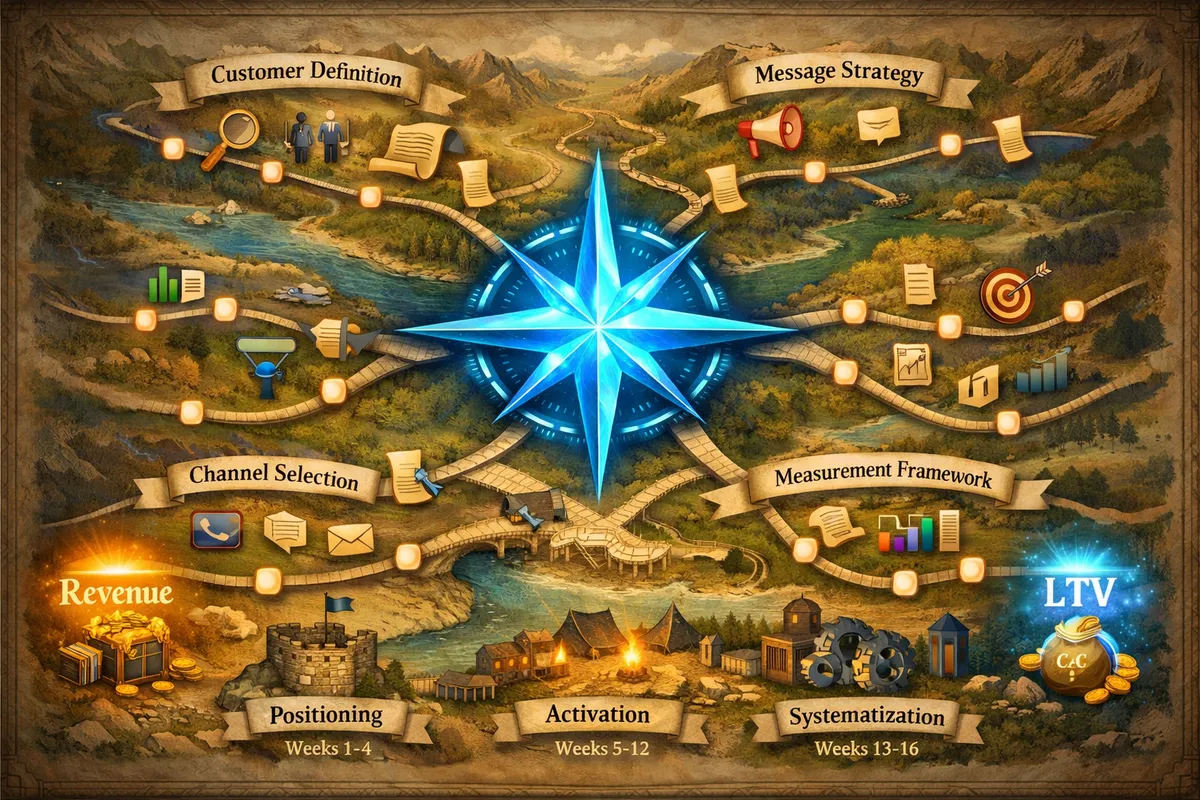
The 90-Day Marketing Execution Plan
Days 1 to 30: Foundation
Week 1: Customer research. Interview 10 to 15 potential customers. Validate your problem hypothesis. Document their language, objections, and decision-making process. In Detroit, this is easier than most cities. Walk into TechTown, attend a startup meetup at Campus Martius, or post in local founder communities. The feedback you need is accessible.
Week 2: Positioning and messaging. Write your value proposition, elevator pitch, and core messages for each audience segment. Test these messages in real conversations before committing them to marketing materials.
Week 3: Infrastructure. Launch or optimize your website. Set up analytics. Configure your CRM. Build your email list infrastructure. Claim your Google Business Profile with your Detroit address.
Week 4: Content foundation. Publish your first 4 pieces of content targeting high-intent keywords. Set up your social media profiles with consistent branding. Begin building your email list.
Days 31 to 60: Testing
Run parallel channel tests. Allocate $300 to $1,000 per channel. Test 4 to 6 channels simultaneously. For Detroit B2B startups, this typically includes LinkedIn ads, Google search ads, content marketing, cold outreach, and local community engagement. For consumer businesses, Instagram, Facebook groups, and local partnerships.
Measure rigorously. Track cost per lead, cost per customer, and conversion rates at each funnel stage. After 30 days, you have data on which channels show promise.
Engage the Detroit community. Attend events. Speak at meetups. Build relationships with other founders along the Woodward Avenue tech corridor. These activities do not scale, but they build the initial traction and credibility that scaled channels amplify.
Days 61 to 90: Scale and Optimize
Double down on winners. Take the top 2 to 3 channels from your testing phase and invest 80% of your budget there. Cut channels that did not perform.
Optimize conversion. A/B test your landing pages, email subject lines, and ad creative. Small improvements in conversion rates compound into significant revenue differences.
Build systems. Automate lead nurturing, follow-up sequences, and reporting. Document your processes so they can be delegated as you grow.
Report and adjust. Review your metrics against your targets. What is working? What is not? Adjust your plan based on evidence, not assumptions.
Marketing Plans by Business Type
For a Detroit B2B SaaS startup: LinkedIn advertising, content marketing targeting industry-specific keywords, cold email outreach to companies in the automotive corridor and healthcare ecosystem, partnerships with complementary tools, and speaking at industry events. Budget: $3,000 to $8,000/month.
For a Detroit consumer startup: Instagram and TikTok content, local influencer partnerships, community events at Eastern Market and Corktown festivals, Google Ads for high-intent searches, and referral programs. Budget: $2,000 to $5,000/month.
For a Detroit service business: Local SEO and Google Business Profile optimization, Google Ads targeting neighborhood-specific searches, email marketing to past clients, and referral systems through your professional network. Budget: $1,500 to $3,000/month.
For a Detroit e-commerce startup: Paid social ads on Meta platforms, email marketing with automated sequences, SEO for product-related keywords, SMS marketing for repeat purchases, and local pop-up events for brand awareness. Budget: $2,000 to $6,000/month.
Common Marketing Plan Mistakes
Planning without executing. A beautiful strategy deck means nothing if nobody executes it. Build plans that are actionable on day one. No 100-page decks that collect dust.
Targeting too broadly. "Everyone who needs marketing" is not a plan. "B2B SaaS companies with 10 to 50 employees in the Detroit metro area" is a plan.
Ignoring unit economics. If your CAC is $500 and your average customer generates $300 in lifetime revenue, more marketing just means losing money faster. Fix your economics before scaling.
Chasing tactics without strategy. "We should try TikTok" is a tactic, not a strategy. Strategy answers: who is our customer, where are they, and what convinces them to buy. Tactics execute that strategy.
Not adjusting based on data. A marketing plan is not permanent. Review monthly. Adjust quarterly. The plan you write on day one will be different from the plan you execute on day 90, and it should be.
Frequently Asked Questions
Q: How much should a Detroit startup budget for marketing?
Most seed-stage startups should allocate 20% to 30% of their burn rate to marketing. For a startup burning $30,000/month, that means $6,000 to $9,000 on marketing. During the testing phase, spread this across multiple channels. Once you identify winners, concentrate spending on the top performers.
Q: How long before a marketing plan produces results?
Paid channels produce leads within days. Email marketing to existing contacts produces results within a week. SEO and content take 3 to 6 months for local Detroit markets. Community-driven marketing takes 3 to 6 months of consistent engagement. The fastest path combines a paid channel for immediate leads with an organic channel for compound growth.
Q: Should I write the marketing plan myself or hire someone?
Write the first version yourself. Nobody knows your customer, product, and competitive landscape better than you. Then bring in expertise to refine, validate, and add tactical depth. A marketing professional can identify channels you have not considered and optimize your approach based on experience with similar businesses.
Q: How often should I update my marketing plan?
Review metrics monthly. Make tactical adjustments monthly. Do a deeper strategic review quarterly. Rewrite the plan annually or when a major change occurs (new product, new market, new funding round). The plan is a living document that evolves with your business.
Q: What is the biggest marketing mistake Detroit startups make?
Not starting. Founders delay marketing until the product is "ready." But the product is never ready, and every month without marketing is a month of missed customer feedback, missed revenue, and missed learning. Start marketing the day you start building. The feedback will make your product better.
Q: How do I leverage Detroit's startup community in my marketing plan?
Budget time (not just money) for community engagement. Attend TechTown events, Build Institute workshops, and startup meetups. Speak when you can. Share your journey publicly on LinkedIn. Offer value to other founders. These activities build the trust and relationships that generate your first 10 to 20 customers in Detroit. Then your digital channels scale that initial traction to a wider audience.