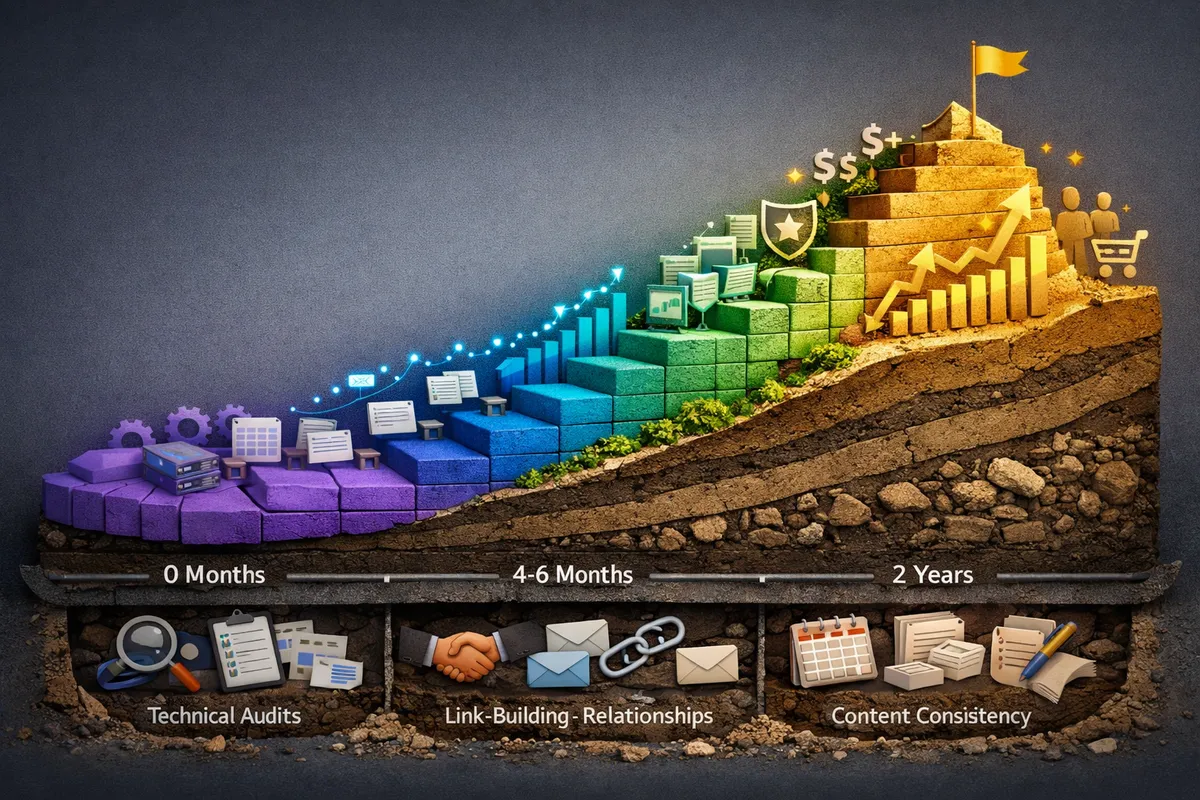
Technical SEO Foundation
Google needs to crawl, understand, and trust your site before it ranks your pages. Most startup websites built on templated platforms have technical SEO problems that silently prevent rankings.
Site Speed and Core Web Vitals
Page speed is a direct ranking factor. Google measures three Core Web Vitals: Largest Contentful Paint (LCP, how fast your main content loads), Interaction to Next Paint (INP, how fast your site responds to interaction), and Cumulative Layout Shift (CLS, visual stability during loading).
Your target is an LCP under 2.5 seconds, INP under 200 milliseconds, and CLS under 0.1. Most template-based startup sites fail at least one of these metrics. Building on modern frameworks like Next.js achieves all three targets. Detroit users on mobile, browsing during commutes along Woodward Avenue or waiting at Campus Martius, need your site to load fast on cellular connections.
Crawlability and Indexing
Google can only rank pages it can find. Technical crawlability issues block rankings silently. Key elements include XML sitemaps listing every page you want indexed, robots.txt configured correctly, canonical tags preventing duplicate content penalties, and internal linking architecture that distributes authority and helps Google discover new content quickly.
Structured Data
Structured data tells Google exactly what your page is about. It enables rich snippets in search results: star ratings, FAQ dropdowns, pricing information, and breadcrumb navigation. Pages with rich snippets earn 20% to 30% higher click-through rates than plain listings.
We implement JSON-LD structured data for key page types: Organization schema for your homepage, Product schema for features, FAQ schema for content pages, and Article schema for blog posts.
Mobile Optimization
Google uses mobile-first indexing, meaning it evaluates the mobile version of your site for rankings. If your mobile experience is poor, your rankings suffer across all devices.
Content Strategy for Detroit Startup SEO
Content is how you tell Google what you are an expert in. Startup content strategy needs to balance three types of content.
Bottom-of-Funnel Content (Conversion)
These pages target searchers who are ready to buy. Comparison pages ("YourProduct vs. CompetitorA"), alternative pages, feature pages, and use case pages. This content converts at 5% to 15% because the searcher already knows they want a solution.
A SaaS startup should create 10 to 15 bottom-of-funnel pages in their first 3 months. For Detroit startups, add location-specific pages targeting terms like "marketing automation Detroit" or "CRM for Michigan small businesses."
Middle-of-Funnel Content (Consideration)
These pages target searchers evaluating solutions. Buying guides, how-to guides, and industry benchmarks. "How to choose a CRM for your startup" or "B2B email marketing benchmarks." This content establishes authority and captures email addresses from prospects who are not ready to buy today but will be in 30 to 90 days.
Top-of-Funnel Content (Awareness)
Educational blog posts, industry trends, and thought leadership pieces. This content builds domain authority and drives backlinks, which strengthen the rankings of your conversion-focused pages.
A publishing cadence of 8 to 12 pieces per month, maintained for 12 months, produces 96 to 144 indexed pages, each targeting specific keywords your customers search for.
Local SEO for Detroit Startups
If your startup serves local customers or operates in a specific geographic area, local SEO is essential.
Google Business Profile optimization. Complete every section with your Detroit address, service areas (Corktown, Midtown, Eastern Market, Ferndale, Royal Oak, and beyond), photos of your office and team, and weekly posts. Businesses with complete profiles receive 7x more clicks.
Local keyword targeting. Create content targeting "[your service] Detroit," "[your service] Michigan," and neighborhood-specific terms. "Marketing agency Corktown" or "SaaS development Midtown Detroit" attract hyper-local searchers who are ready to buy.
Local citations. Consistent business information across directories (Yelp, BBB, Clutch, industry-specific directories) builds local authority. Inconsistent name, address, or phone number across listings hurts rankings.
Review generation. Google reviews directly influence local pack rankings. A startup with 25 reviews and a 4.5 rating appears above competitors with fewer or lower-rated reviews. Systematic review requests after positive customer interactions build this asset steadily.
Link Building for Detroit Startups
Backlinks from other websites signal to Google that your content is trustworthy and authoritative. Quality matters more than quantity.
Local media and publications. Crain's Detroit Business, local tech blogs, and industry publications covering the Detroit startup ecosystem are excellent link sources. A feature article or founder interview creates a high-authority backlink while building brand awareness.
Partnerships and co-marketing. When you partner with another Detroit company, co-publish a case study or blog post. Both sites link to the shared content, benefiting both domains.
Community involvement. TechTown, Build Institute, Wayne State, and other Detroit organizations often link to companies in their ecosystem from their websites. Being an active community member generates organic backlinks.
Guest posting. Writing for industry blogs and publications that your customers read builds both authority and backlinks. Prioritize publications relevant to your industry rather than generic marketing blogs.
SEO Strategy for Resource-Constrained Detroit Startups
You have limited resources. You need SEO that is fast to implement and delivers results early.
Focus on high-intent search terms. Keywords that indicate someone is ready to buy or take action. For a SaaS startup in Corktown: "project management software for agencies" beats "project management philosophy." For a service business in Midtown: "LinkedIn marketing consultant Detroit" beats "why LinkedIn matters."
Start with your homepage and core service pages. Optimize title tags, meta descriptions, heading structure, and content for your primary keywords. These quick wins can improve rankings within weeks.
Build a content calendar around customer questions. The questions your prospects ask during sales calls are the keywords they search on Google. Answer those questions thoroughly in blog posts.
Measure at months one, three, and six. Some keywords rank quickly. Others take longer. Double down on what works. Adjust what does not.
Frequently Asked Questions
Q: How long does it take for SEO to work for a Detroit startup?
Initial improvements in local rankings can appear within 4 to 8 weeks for low-competition Detroit-specific keywords. More competitive terms take 3 to 6 months. A comprehensive SEO program typically produces meaningful organic traffic growth by month 6 and becomes a primary acquisition channel by month 12 to 18.
Q: How much should a Detroit startup invest in SEO?
Most startups should budget $1,500 to $5,000/month for SEO including content production, technical optimization, and link building. For startups with very limited budgets, $500 to $1,000/month focused on local SEO and technical foundations can still produce meaningful results for Detroit-specific searches. The ROI on SEO typically exceeds every other channel within 12 months because the traffic is ongoing and the marginal cost approaches zero.
Q: Can a startup do SEO in-house or should we hire an agency?
Technical SEO setup and initial strategy benefit from professional expertise. Ongoing content creation can often be handled in-house with guidance. Many Detroit startups work with an agency for the first 3 to 6 months to build the foundation and strategy, then transition to in-house execution with periodic agency check-ins.
Q: What SEO tools should a Detroit startup use?
Start with free tools: Google Search Console, Google Analytics, and Google Business Profile. As you grow, add a keyword research tool (Ahrefs, SEMrush, or Ubersuggest), a rank tracking tool, and a site audit tool. Total cost for essential paid tools runs $100 to $300/month.
Q: Should I prioritize local SEO or general SEO?
If you serve Detroit customers or operate in a specific geographic area, prioritize local SEO first. Local SEO produces results faster and targets higher-intent searches. A Detroit-based consultant ranking for "business consultant Midtown Detroit" will see leads faster than ranking for "business consulting tips." Once your local foundation is solid, expand to broader terms.
Q: How does SEO fit with paid advertising for a Detroit startup?
Use paid ads for immediate results while SEO builds. PPC identifies which keywords convert, providing data that informs your SEO content strategy. As organic rankings improve, you can reduce ad spend on keywords where you rank organically, effectively replacing rented traffic with owned traffic. The best strategy runs both in parallel: PPC for speed, SEO for compound growth.