When Custom Software Creates Advantage
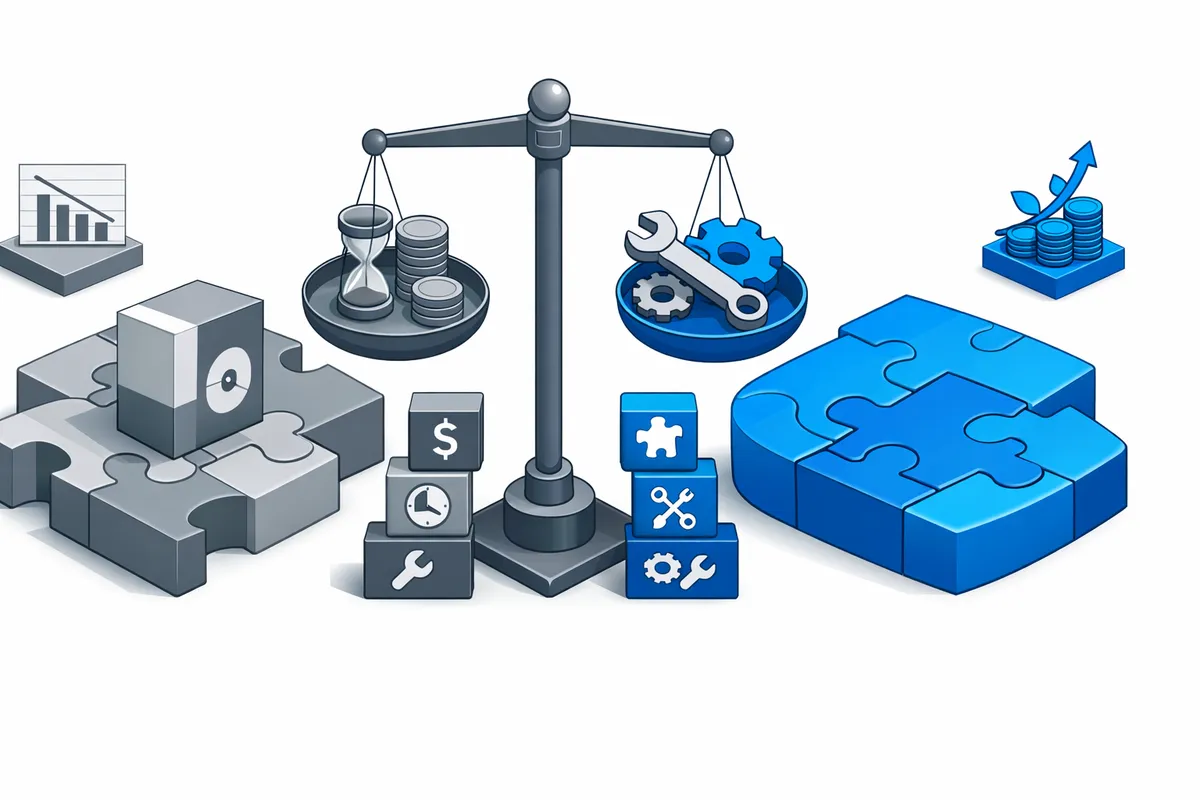
Custom development makes sense when your core processes are unique and that uniqueness creates competitive advantage.
Your process IS your product. This applies beyond SaaS startups. A Wall Street quantitative trading firm with proprietary models needs custom trading infrastructure. A Brooklyn logistics company with unique routing algorithms needs custom dispatch software. A Manhattan healthcare startup with a novel patient engagement approach needs a custom portal.
You have outgrown existing tools. When your team has tried 3+ solutions and each fails on the same critical requirements, the market is telling you that your needs fall outside standard use cases. Excessive workarounds, manual processes that negate efficiency, and team frustration driving low adoption are all symptoms.
Data is your competitive advantage. Businesses collecting unique data and using it for better decisions need custom systems. A SoHo retail brand with proprietary demand forecasting, a fintech startup with unique risk scoring, or an ad tech company with custom attribution models all benefit from purpose-built software.
Integration depth matters. When you need deep, bidirectional integration with proprietary systems, legacy databases, or specialized hardware, off-the-shelf tools struggle.
Vendor dependency is unacceptable. You control the roadmap, data, and integrations. No surprise price increases. No discontinued features. No vendor acquisition changing the product. For New York businesses where technology is core to operations, this control is worth the investment.
Examples of Custom Software Creating Value
Internal operations platform. A 150-person Manhattan professional services firm replaced 7 SaaS tools with one custom platform. Annual SaaS spend dropped from $180,000 to $35,000 in hosting and maintenance. Processes requiring 4 tools and manual transfer now happen in one system, saving an estimated 400 hours monthly.
Customer-facing portal. A Brooklyn B2B manufacturer built a custom ordering portal integrating inventory, pricing, and shipping. Order processing time dropped from 48 hours to 15 minutes. Order errors fell 85%.
Proprietary analytics. A Midtown marketing agency built custom reporting that pulls from 12 platforms and applies proprietary attribution models. What took analysts 6 hours per client per month now takes 20 minutes of review. The analytics became a competitive differentiator in new business pitches.
Cost Analysis: Short-Term vs Long-Term
Year 1 Comparison
| Factor | Off-the-Shelf (10 users) | Custom Software |
|---|---|---|
| Software/Development | $12,000 to $60,000 | $50,000 to $250,000 |
| Implementation/Setup | $5,000 to $15,000 | Included in development |
| Integration Work | $5,000 to $20,000 | Built into architecture |
| Training | $2,000 to $5,000 | $3,000 to $8,000 |
| Total Year 1 | $24,000 to $100,000 | $53,000 to $258,000 |
Off-the-shelf wins year 1 in most cases.
5-Year Total Cost of Ownership
| Factor | Off-the-Shelf (10-20 users) | Custom Software |
|---|---|---|
| Subscriptions (cumulative) | $100,000 to $400,000 | $0 |
| Hosting/Infrastructure | Included | $30,000 to $60,000 |
| Maintenance/Updates | Included | $50,000 to $150,000 |
| Feature Development | $0 (accept vendor ships) | $30,000 to $100,000 |
| Integration Maintenance | $15,000 to $50,000 | $10,000 to $30,000 |
| Workaround Productivity Cost | $75,000 to $200,000 | Minimal |
| Total 5-Year | $190,000 to $650,000 | $173,000 to $598,000 |
Over 5 years, costs converge. With New York's higher labor rates, the workaround productivity cost line inflates significantly, often making custom the cheaper option by year 3. The breakeven typically falls between year 2 and year 4.
When Custom Is Clearly Cheaper
Custom becomes the obvious financial choice when you are replacing 5+ SaaS subscriptions, your team exceeds 20 users, you plan to use the software for 5+ years, workaround costs exceed $50,000 annually, or you need integrations vendors do not support natively.
The Hybrid Approach
Most New York businesses benefit from combining both. Use off-the-shelf for standard functions and build custom for competitive differentiators.
Buy these. Accounting, email, team chat, file storage, basic marketing tools. Commodity functions where custom adds no competitive value.
Build these. Customer-facing portals, proprietary workflow tools, internal platforms encoding unique processes, analytics with proprietary metrics, integration layers connecting disparate systems.
Evaluate case-by-case. CRM, project management, support tools, booking systems. The answer depends on how central the function is to your competitive advantage. A Flatiron real estate tech startup may need a custom CRM because their deal flow process is fundamentally different from what HubSpot assumes. A Chelsea consulting firm may be perfectly served by Pipedrive.
A typical hybrid architecture: QuickBooks for accounting (off-the-shelf), custom client portal for customer interactions, HubSpot for marketing automation (integrated via API), custom analytics dashboard pulling from all systems, Slack for internal communication. The custom components connect to off-the-shelf tools through APIs. Data flows automatically.
Making the Decision: Practical Framework
Step 1: Audit your stack. List every tool, monthly cost per user, workflow fit (1 to 10), weekly workaround hours, and integration pain points.
Step 2: Identify differentiators. Which processes make you different? Which create customer value? Those are candidates for custom.
Step 3: Calculate true costs. Project total ownership over 3 to 5 years including subscriptions, per-seat costs at projected team size, integrations, training, maintenance, and workaround productivity costs at New York rates.
Step 4: Assess technical readiness. Do you have developers or a trusted partner for ongoing maintenance? Custom software without maintenance becomes a liability.
Step 5: Start small. If analysis points to custom, build one high-impact module first. Prove value before replacing your entire stack.
FAQ
Q: At what company size does custom software make sense for New York businesses?
Companies with 10 to 20 employees typically start feeling off-the-shelf limitations. At 20 to 50, SaaS costs and workaround inefficiencies often justify custom investment. At 50+, nearly all have at least one custom system. The real trigger is process uniqueness and SaaS spend. A 15-person New York company spending $80,000 yearly on SaaS with significant workarounds has a strong case for custom.
Q: How long does custom software development take?
A focused single-purpose application takes 2 to 4 months. A comprehensive platform replacing multiple tools takes 4 to 9 months. Complex systems with AI and real-time processing take 6 to 12+ months. We recommend phased delivery: launch a core version at 3 months and add features in subsequent releases.
Q: What if requirements change after development starts?
They always do. Good practices account for this through modular architecture, iterative development with review cycles, and clear change management. We use 2-week sprints with demos and feedback. Course corrections happen frequently and cheaply rather than rarely and expensively.
Q: Can custom software integrate with our existing off-the-shelf tools?
Yes. Modern development uses APIs to connect systems. Most SaaS tools provide APIs for this purpose. A custom platform reads from and writes to your CRM, accounting software, email platform, and other tools. Legacy systems without APIs require custom integration approaches, but this is solvable in virtually every case.
Q: What happens if the development company goes out of business?
Protect yourself: all code in your repository, documentation of architecture and deployment, common technologies with large developer communities, and deliverable code any competent developer can maintain. Following these practices makes transitioning partners straightforward. In New York's deep talent market, replacement options exist.
Q: Should I build custom or hire more people?
Compare directly. If manual processes require 2 people at $60,000/year each in New York ($120,000 annually), and custom software costs $75,000 to build with $15,000/year maintenance, the software pays for itself in under 12 months. Software also scales without proportional cost. Handling 2x volume does not require 2x software investment, but it requires 2x people.