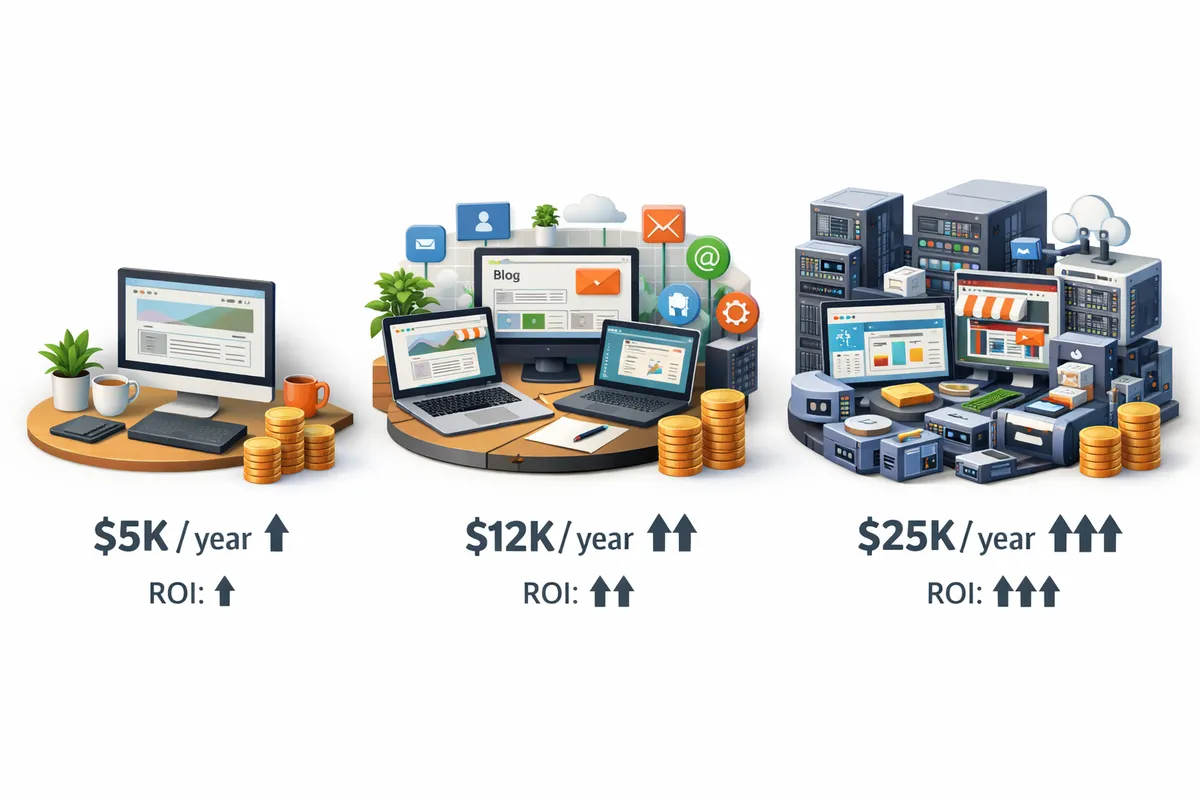
What You Get at Each Price Point
Understanding what each price tier includes helps you make an informed decision based on your actual business needs.
$1,000 to $2,500: Template Websites
What you get. A pre-built template customized with your branding, colors, and content. Typically built on Squarespace, Wix, or a basic WordPress theme. Three to five pages. Stock photography. Mobile-responsive (because the template handles this). Basic contact form. No custom design work.
What you do not get. SEO optimization beyond the basics. Conversion optimization. Custom functionality. Fast page load speeds (template sites carry significant bloat). Unique design that differentiates you from competitors using the same template. Ongoing support or optimization.
Good for: Side projects, placeholder sites while you validate a business idea, businesses where the website is not a primary customer acquisition channel.
Not good for: Businesses that rely on their website to attract and convert customers. Any business competing in a crowded New York market where first impressions matter.
$3,000 to $7,000: Professional Small Business Websites
What you get. Custom design tailored to your brand and target audience. Five to ten pages with conversion-optimized layouts. Professional copywriting assistance. Mobile-first responsive design. Fast page load speeds. Basic SEO setup (title tags, meta descriptions, header structure, sitemap). Contact forms with proper functionality. Analytics integration. Local SEO foundation (schema markup, Google Business Profile integration).
What you do not get. Complex functionality (e-commerce, booking systems, member portals). Ongoing content creation. Extensive SEO campaigns. Advanced integrations with third-party tools.
Good for: Serious small businesses that need a professional web presence. Service providers in Manhattan and Brooklyn. Local shops, restaurants, and professional practices. Early-stage startups establishing credibility. This is the sweet spot for most small businesses in New York.
Running Start Digital starts here because this is the minimum investment that produces a site capable of actually generating business results.
$7,000 to $15,000: Growth-Oriented Websites
What you get. Everything in the professional tier plus: comprehensive SEO strategy and implementation. Content management system for easy updates. Blog or content section for organic traffic growth. E-commerce functionality (Shopify integration or custom). Booking or scheduling systems. Email capture with automated welcome sequences. Integration with CRM and marketing tools. Multiple landing pages for different services or campaigns. Advanced analytics with conversion tracking.
Good for: Businesses planning to grow through their website. Startups with active marketing programs. E-commerce businesses. Service businesses in competitive New York markets where organic search traffic is critical.
$15,000 to $30,000+: Custom Web Applications
What you get. Full custom development. Complex functionality (member portals, dashboards, custom workflows). Advanced integrations. Custom backend development. Scalable architecture. Multi-user systems. API development. Enterprise-grade performance and security.
Good for: SaaS products, marketplaces, fintech platforms, and businesses where the website is the product. Startups that need custom functionality not available in off-the-shelf solutions.
Why New York Website Prices Are Higher Than National Averages
Website costs in New York run 20% to 40% higher than national averages. This is not arbitrary markup. It reflects three realities.
Talent costs. Designers and developers in Brooklyn, Manhattan, and the surrounding boroughs command higher rates than their counterparts in lower-cost markets. A senior web developer in Flatiron charges $150 to $250/hour. The same skill set in a mid-tier city charges $75 to $125/hour. You pay more, but you get professionals embedded in one of the most competitive digital markets in the world.
Market expectations. New York customers, investors, and partners have higher standards for web design and user experience because they interact with world-class digital products daily. A website that would impress in a smaller market looks dated in Manhattan. Meeting New York expectations requires more design refinement and development attention.
Competitive pressure. Your New York competitors have good websites. A mediocre site does not just fail to impress. It actively hurts you by looking inferior to competitors who invested properly. The price premium for New York web development reflects the need to meet or exceed the competitive standard in your market.
This is actually an advantage for your business. When you invest in quality web design in New York, it signals credibility. Customers trust businesses that clearly invest in their presence. Investors respect founders who understand the importance of first impressions. The website investment pays for itself through the trust and conversions it generates.
The ROI Calculation
Website cost is not an expense. It is an investment. Here is how to calculate whether the investment makes sense for your business.
Revenue-based ROI. If your website costs $5,000 and brings in one additional customer per month at $500 revenue, it pays for itself in ten months. If it brings two customers per month, five months. If your average customer value is $2,000, the site pays for itself with three new customers. Most well-built New York small business websites generate positive ROI within six months.
Opportunity cost of a bad website. Every visitor who leaves your cheap, slow, or confusing website is a potential customer lost. If your site receives 500 visitors per month and converts at 1% instead of the 3% a professional site would achieve, you are losing 10 customers per month. At $500 per customer, that is $5,000/month in lost revenue. The "savings" from a cheap website cost you $60,000/year in lost business.
Cost of credibility. In B2B markets across Manhattan and Brooklyn, your website is often the deciding factor in whether a prospect takes your call. A professional site that clearly communicates competence and trustworthiness does not just attract customers. It enables higher pricing because you are perceived as a premium provider. A consultant with a $10,000 website can charge $300/hour. The same consultant with a $500 website struggles to charge $150/hour. The website investment enables premium positioning that compounds over years.
Comparison to other marketing costs. A $5,000 website lasts three to five years and works 24/7. A single trade show booth in New York costs $3,000 to $10,000 for three days. Six months of Google Ads at $500/month costs $3,000 and stops generating leads the moment you stop paying. The website is the most durable marketing asset you can invest in.
Hidden Costs to Watch For
Not all website pricing is transparent. Here are the costs that surprise small business owners.
Hosting. $10 to $100/month depending on the platform and traffic volume. Budget for this ongoing cost. Cheap hosting often means slow load speeds and poor uptime, which directly affects your Google ranking and customer experience.
Domain name. $10 to $50/year for a standard .com domain. Premium domains (short, exact-match keywords) can cost hundreds or thousands. Your domain is a long-term brand asset worth investing in.
SSL certificate. Required for security (the padlock icon in browsers). Most hosting providers include this free. If yours does not, budget $50 to $200/year. Google penalizes sites without SSL.
Content creation. The website design is the container. The content is what fills it. If you cannot write your own website copy, budget $500 to $2,000 for professional copywriting. Good copy converts. Bad copy wastes a good design.
Photography. Professional photos of your business, products, and team cost $300 to $1,500 for a half-day shoot. This is worth every dollar. Stock photography makes your site look generic. Real photos build trust and authenticity.
Ongoing maintenance. Software updates, security patches, content updates, and technical support. Budget $100 to $500/month for basic maintenance, or $500 to $1,500/month for active management that includes content updates and minor improvements.
Plugin and integration costs. Booking systems, email marketing integrations, CRM connections, and other third-party tools often carry monthly subscription fees. These range from $10 to $200/month each depending on the tool.
DIY vs. Professional: When Each Makes Sense
DIY with website builders (Squarespace, Wix, Shopify). Makes sense if: your budget is under $2,000, you have time to learn the platform, your website requirements are straightforward, and you have an eye for design. Cost: $200 to $500/year for the platform plus your time.
Professional development. Makes sense if: your website is a primary customer acquisition tool, you operate in a competitive New York market, you need custom functionality, you want SEO optimization, and you value your time more than the cost difference. Cost: $3,000 to $30,000+ depending on scope.
The hybrid approach. Start with a DIY builder to validate your business concept. Invest in professional development once revenue justifies the investment. Many successful New York small businesses started with a $200 Squarespace site and graduated to a $7,000 custom site after their first year of proven demand.
Choosing the Right Web Developer in New York
Portfolio review. Look at sites they have built for businesses similar to yours. Do those sites load fast? Are they well-designed? Do they appear to convert visitors? A developer's portfolio is the best predictor of what they will build for you.
Transparent pricing. Avoid developers who cannot provide a clear project estimate. Fixed-price projects with defined scope protect you from budget overruns. Hourly billing without a scope definition is a recipe for unexpected costs.
Process and timeline. A professional developer has a clear process: discovery, design, development, testing, launch. They can tell you exactly how long each phase takes and what your involvement looks like. Vague timelines indicate disorganized execution.
Post-launch support. Ask what happens after launch. Do they offer maintenance plans? How quickly do they respond to issues? What does a content update cost? The relationship does not end at launch. Your developer should be a long-term partner.
Local vs. remote. Working with a New York developer offers in-person meetings, local market understanding, and timezone alignment. Remote developers can be more affordable but may lack context about New York's specific market dynamics. For most small businesses, local developers are worth the premium.
Why New York Businesses Choose Running Start Digital
We price transparently. No surprise invoices. No feature creep. One project fee for clear deliverables. We have built websites for businesses across all five boroughs, from Astoria to Fort Greene, from Tribeca to Bushwick.
Our sites convert because we optimize for your customer, not for our portfolio. Brooklyn entrepreneurs, Manhattan startups, Queens service businesses, and Lower East Side retailers all get sites that work for their specific market and customer base.
We build sites that grow with your business. Your first website is not your last website. We build foundations that support growth, not dead ends that require rebuilding when your business outgrows them.
Frequently Asked Questions
Q: What is the minimum I should spend on a small business website in New York?
$3,000 to $5,000 for a professional site that actually generates business results. Below that, you are getting a template that will not differentiate you from competitors or convert visitors into customers. If your budget is truly under $3,000, start with a well-designed Squarespace site and plan to invest in professional development within 12 months.
Q: How long does it take to build a small business website?
A professional small business website takes three to four weeks from kickoff to launch. More complex sites with e-commerce or custom functionality take four to eight weeks. Template sites can be built in one to two weeks. Rush timelines are possible but often cost 25% to 50% more.
Q: Should I use WordPress, Squarespace, or a custom build?
For most small businesses in New York, a custom-built site on Next.js or a similar modern framework provides the best performance and long-term value. WordPress works but requires ongoing maintenance and often becomes slow as plugins accumulate. Squarespace works for simple sites that will not change much but limits customization and growth.
Q: Do I need a new website or can I improve my existing one?
If your current site is built on a modern platform, redesigning and optimizing it is often more cost-effective than starting over. If your site is built on an outdated platform, is very slow, or has fundamental structural problems, starting fresh is usually the better investment.
Q: What is the ongoing cost of maintaining a website?
Budget $100 to $500/month for hosting, domain, SSL, and basic maintenance. Add $200 to $500/month if you want regular content updates and optimization. Total ongoing cost for most New York small business websites is $200 to $800/month.
Q: Can a good website really justify its cost for a small business?
Yes. A website that converts visitors into customers at even a modest rate typically pays for itself within six to twelve months. The math is straightforward: if your site generates two additional customers per month at $300 average value, that is $7,200 in annual revenue from a $5,000 investment. The website becomes the most cost-effective marketing asset you own.
[Get Your Website Pricing]