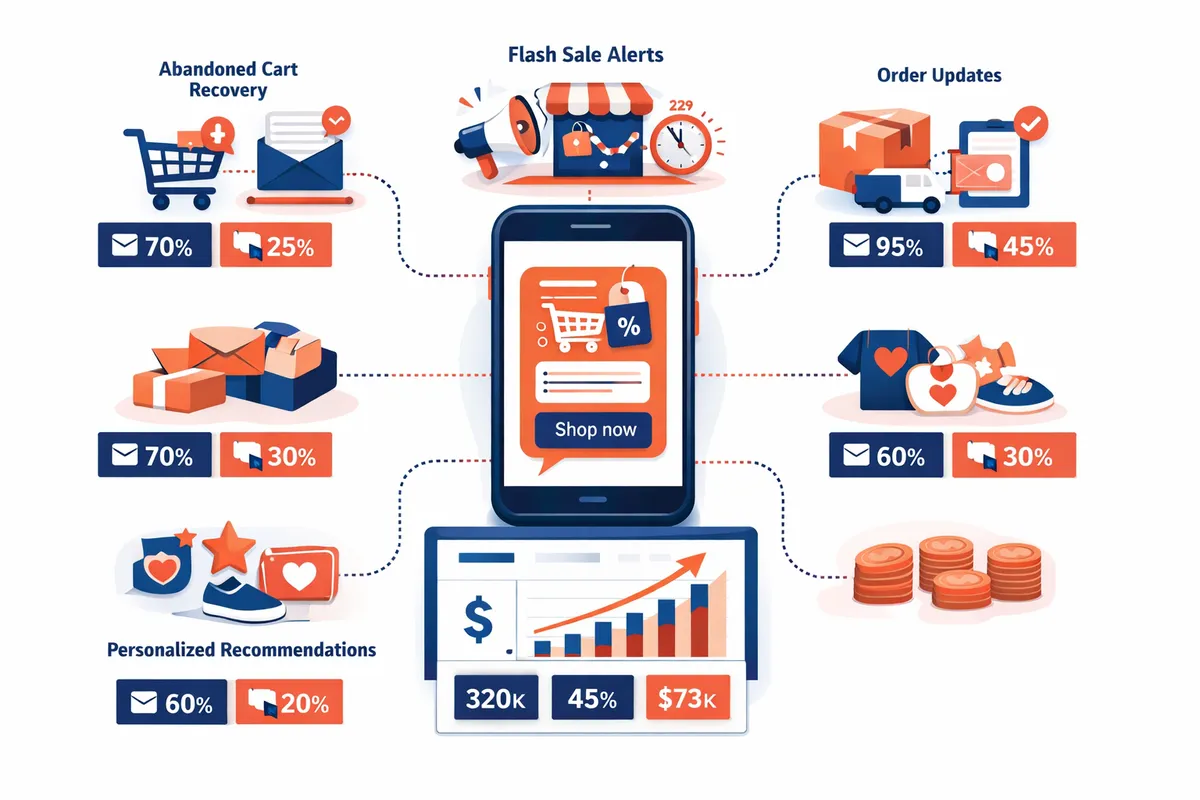
The Core SMS Campaigns Every E-Commerce Business Needs
Not all SMS campaigns are equal. Some drive immediate revenue. Some build long-term customer value. Some prevent revenue loss. Here are the campaigns that produce the highest returns for New York e-commerce businesses.
Abandoned Cart Recovery
This is the single highest-ROI SMS campaign for most e-commerce businesses. A customer adds products to their cart and leaves without purchasing. One to two hours later, they receive a text message reminding them about the items they left behind, often with a small incentive to complete the purchase.
New York shoppers are especially prone to cart abandonment because they shop in short mobile sessions during commutes and breaks. They get distracted. They arrive at their destination. They forget. An SMS arriving one to two hours after abandonment catches them during their next idle moment and brings them back.
Recovery rates from SMS abandoned cart messages typically range from 10% to 25%, compared to 3% to 8% for email abandoned cart messages. For an e-commerce business losing $10,000/month in abandoned carts, a 15% recovery rate represents $1,500/month in recaptured revenue from a single automated SMS flow.
Best practices for abandoned cart SMS. Send the first message one to two hours after abandonment. Include the product name and a link directly to the cart. Keep the message under 160 characters. Test with and without a discount incentive. Some brands find that a simple reminder without a discount recovers nearly as well, which protects margins.
Welcome Series
New subscriber welcome messages set expectations and drive first purchases. A two to three message welcome series over the first week introduces your brand, shares a first-purchase incentive, and highlights your most popular products.
Message one (immediate). Thank them for subscribing. Deliver the opt-in incentive (discount code, free shipping, etc.). Set expectations for message frequency.
Message two (day two to three). Share your most popular products or best sellers. Social proof: customer reviews or user-generated content. Create urgency if the welcome discount has an expiration.
Message three (day five to seven). Final reminder about the welcome offer if they have not purchased. Introduce a product category they might have missed. Reinforcement of what makes your brand unique.
Welcome series typically produce 30% to 50% higher conversion rates than ongoing promotional messages because the subscriber just expressed interest by opting in.
Flash Sales and Time-Sensitive Promotions
SMS excels at creating urgency. A flash sale announced via text message feels immediate and exclusive in a way that email cannot replicate. New York shoppers respond to urgency because the city runs on speed and scarcity.
24-hour flash sales. Announce the sale via SMS at launch. Send a reminder at the halfway point. Send a final reminder in the last two hours. Three messages over 24 hours drive the majority of flash sale revenue.
New York-specific promotions. Tie promotions to local events and moments. Fashion Week discounts. Holiday weekend sales. Weather-triggered promotions (rainy day comfort items, heat wave summer essentials). NYC marathon merchandise. These localized promotions feel relevant and timely to New York customers.
Exclusive SMS-only offers. Give SMS subscribers access to deals not available through email or social media. This exclusivity increases opt-in rates and reduces unsubscribes because subscribers feel they are part of a privileged group.
Post-Purchase Follow-Up
The sale is not the end of the customer journey. Post-purchase SMS messages build loyalty and drive repeat purchases.
Shipping confirmations and tracking. Customers expect to know when their order ships and when it arrives. SMS delivery updates have higher open rates than email and reduce "where is my order" support inquiries.
Review requests. Three to five days after delivery, send a text asking for a product review. SMS review requests produce 5x to 10x higher response rates than email review requests. These reviews build social proof that drives future sales.
Replenishment reminders. For consumable products, timed reminders to reorder drive repeat purchases with minimal effort. A skincare brand sending a reorder reminder 25 days after purchase catches the customer right when they are running low.
Cross-sell recommendations. Based on purchase history, recommend complementary products via SMS. A customer who bought running shoes might appreciate a message about running accessories two weeks later.
Win-Back Campaigns
Customers who have not purchased in 60 to 90 days receive targeted messages to re-engage them. These campaigns prevent churn and reactivate customers at a fraction of the cost of acquiring new ones.
Win-back sequence. Start with a personalized message acknowledging their absence. Offer an incentive to return (discount, free shipping, early access). Share new products or improvements since their last purchase. If no response after three messages, reduce frequency to prevent opt-outs.
Win-back campaigns typically recover 5% to 15% of lapsed customers, which directly impacts lifetime value and reduces the pressure on new customer acquisition.
Building a Compliant SMS Program
SMS marketing is regulated more heavily than email. Compliance is not optional. Violations result in significant fines and carrier filtering that can shut down your entire SMS channel.
TCPA compliance. The Telephone Consumer Protection Act requires explicit written consent before sending marketing text messages. This means opt-in forms with clear language about what the subscriber will receive. No pre-checked boxes. No implied consent from purchasing. The subscriber must actively choose to receive texts.
Opt-in best practices. Website pop-ups with clear SMS opt-in language. Checkout page checkboxes (unchecked by default). Keyword opt-ins ("Text JOIN to 55555"). QR codes in physical locations and packaging. Each method must include disclosure about message frequency and data rates.
Opt-out handling. Every message must include opt-out instructions. Standard practice is including "Reply STOP to unsubscribe" in every message or in the initial welcome message. Process opt-outs immediately and automatically. Do not send additional messages to people who have opted out.
Message frequency. Over-messaging is the fastest way to destroy an SMS program. New York consumers are sensitive to intrusion on their personal devices. Four to eight messages per month is the sweet spot for most e-commerce brands. More than ten messages per month dramatically increases unsubscribe rates.
Quiet hours. Do not send messages before 9 AM or after 9 PM in the recipient's local timezone. New York-specific consideration: commute hours (7 to 9 AM and 5 to 7 PM) are actually high-engagement windows because people are on their phones during transit.
Segmentation and Personalization
Mass texting the same message to your entire list is lazy and ineffective. Segmented, personalized SMS campaigns outperform mass blasts by 300% to 500% in conversion rate.
Behavioral segmentation. Segment by purchase history, browsing behavior, cart activity, and engagement with previous messages. A customer who frequently buys from your sale section receives different messages than a customer who buys full-price new arrivals.
Purchase frequency segmentation. VIP customers (5+ purchases) receive exclusive early access and special offers. Occasional customers (1 to 2 purchases) receive incentives to increase purchase frequency. New customers receive onboarding and first-repeat-purchase encouragement.
Geographic segmentation. For e-commerce brands with physical locations or local delivery options, segment by New York neighborhood. A customer in Williamsburg might receive a message about in-store pickup availability at your Brooklyn location. A customer in Manhattan might receive a message about same-day delivery options.
Product interest segmentation. Customers who browse or purchase specific product categories receive messages about those categories. A customer who bought winter accessories receives messages about new winter arrivals. This relevance reduces unsubscribes and increases conversion.
SMS Platform Integration
Your SMS program needs to integrate with your e-commerce platform to enable automated, data-driven messaging.
Shopify integration. Connect your SMS platform to Shopify to trigger automated flows based on customer actions: abandoned carts, completed purchases, order fulfillment, and customer milestones. Product data flows into SMS messages automatically, including images, prices, and direct cart links.
Klaviyo, Postscript, Attentive. These are the leading SMS marketing platforms for e-commerce. Each integrates with major e-commerce platforms and provides segmentation, automation, and analytics capabilities. Pricing typically runs $100 to $500/month plus per-message costs of $0.01 to $0.03 per SMS.
Unified customer profiles. Your SMS platform should share customer data with your email platform and CRM. This prevents sending the same promotion via email and SMS simultaneously and enables coordinated cross-channel campaigns.
Analytics and attribution. Track revenue attributed to each SMS campaign. Measure click-through rates, conversion rates, revenue per message, and unsubscribe rates. Compare SMS performance against other channels to optimize your marketing budget allocation.
Measuring SMS Marketing Performance
Revenue per message. Total revenue attributed to an SMS campaign divided by messages sent. Target $0.50 to $2.00 per message for promotional campaigns. Automated flows (abandoned cart, welcome series) often exceed $2.00 per message.
Click-through rate. Percentage of recipients who click a link in the message. Healthy range is 15% to 30%. Below 10% indicates messaging or timing problems.
Conversion rate. Percentage of clickers who complete a purchase. Healthy range is 5% to 15%. Below 5% indicates landing page or offer problems.
Unsubscribe rate. Percentage of recipients who opt out after a message. Target below 1% per campaign. Above 2% indicates you are sending too frequently or sending irrelevant content.
List growth rate. Net new subscribers per month minus unsubscribes. A healthy SMS list grows 5% to 10% monthly through opt-in campaigns. Stagnant list growth means your opt-in mechanisms need improvement.
Cost per acquisition. SMS platform costs plus message costs divided by new customers acquired through SMS. Compare this against your other acquisition channels to evaluate relative efficiency.
Common SMS Marketing Mistakes
Over-messaging. Sending daily texts burns out your list. New York consumers will unsubscribe fast if they feel spammed. Four to eight messages per month is sustainable.
No segmentation. Sending the same message to every subscriber ignores that your customers have different interests, purchase behaviors, and engagement levels. Segment from day one.
Ignoring compliance. Sending texts without proper opt-in consent violates federal law and risks fines of $500 to $1,500 per message. Invest in compliant opt-in flows from the start.
Treating SMS like email. SMS messages should be short, direct, and action-oriented. Long-form content belongs in email. SMS messages should rarely exceed 160 characters.
No integration with other channels. SMS works best as part of a coordinated marketing program. Coordinate SMS timing with email campaigns, social media promotions, and website activity to create reinforcing touchpoints without overwhelming customers.
Frequently Asked Questions
Q: How much does SMS marketing cost for an e-commerce business?
Platform fees range from $100 to $500/month depending on list size and features. Per-message costs run $0.01 to $0.03 per SMS. A business sending 10,000 messages per month to a 2,500-person list spends approximately $200 to $600/month total. Most businesses see 10x to 30x ROI on their SMS investment.
Q: How many SMS messages should I send per month?
Four to eight messages per month is the sweet spot for most e-commerce brands. This includes both promotional campaigns and automated flows (abandoned cart, shipping updates). Monitor unsubscribe rates closely and reduce frequency if they exceed 1% per campaign.
Q: How do I build an SMS subscriber list from scratch?
Start with your existing customer email list by adding SMS opt-in to your email footer and website. Add SMS opt-in to your checkout flow. Create a website pop-up offering an incentive (10% off first order) for SMS subscribers. Use social media to promote your SMS program. Most brands can build a list of 500 to 1,000 subscribers within 60 to 90 days.
Q: Is SMS marketing effective for high-ticket e-commerce products?
Yes. SMS works for products at all price points, though the approach differs. For high-ticket items, SMS is more effective for re-engagement, back-in-stock alerts, and exclusive access rather than discount-driven flash sales. A luxury goods e-commerce brand uses SMS to notify VIP customers about limited releases rather than 20% off promotions.
Q: Can SMS marketing work alongside my email marketing program?
Yes, and it should. SMS and email are complementary channels. Use email for long-form content, detailed product information, and brand storytelling. Use SMS for time-sensitive promotions, abandoned cart recovery, and shipping updates. Coordinate timing to prevent overwhelming customers with simultaneous messages across both channels.
Q: How quickly can I see results from SMS marketing?
Automated flows (abandoned cart recovery, welcome series) produce measurable revenue within the first week of launch. Promotional campaigns produce results within 24 to 48 hours of sending. Most e-commerce businesses see positive ROI from SMS within the first month of a properly configured program.
[Start Your SMS Program]