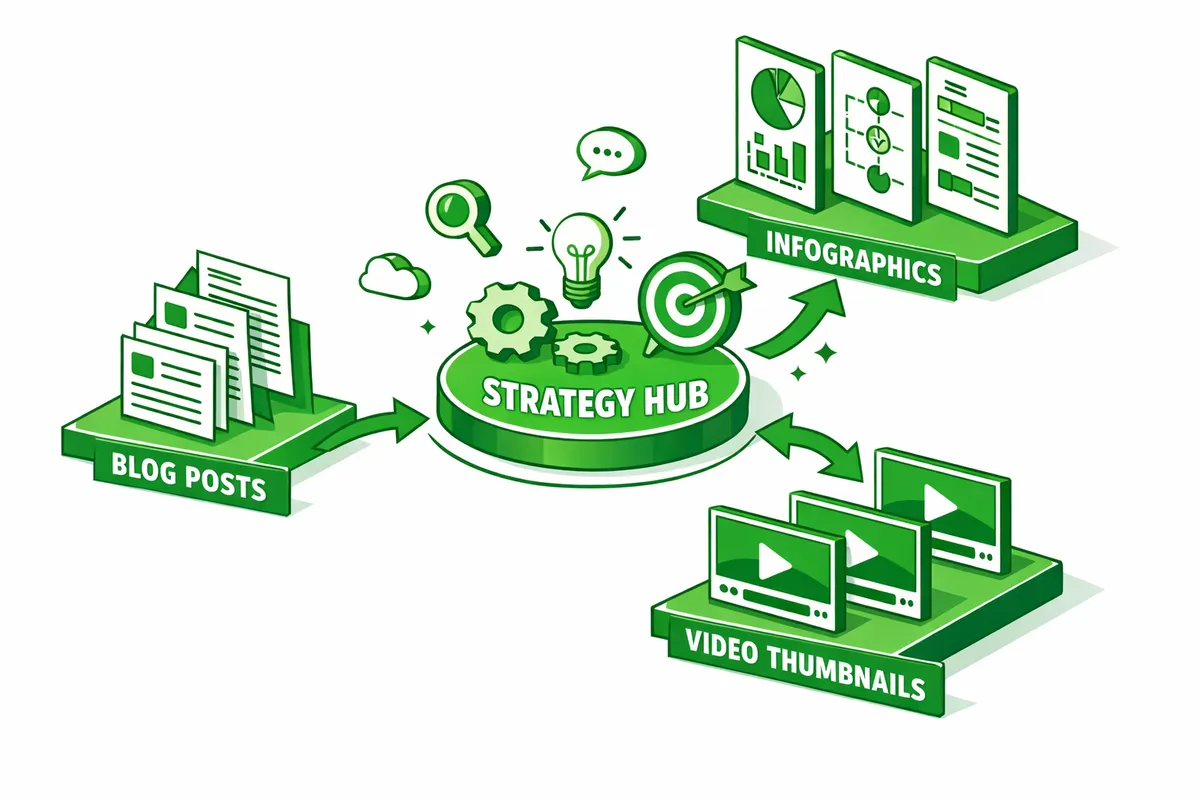
What We Do for Fintech Companies
Content Marketing
Content is the trust-building engine for fintech. Educational content that demonstrates expertise without making claims compliance will reject. Every piece serves a dual purpose: building brand authority and capturing organic search traffic.
Whitepapers and research reports. Original research positions your company as a thought leader. A whitepaper analyzing trends in embedded finance, payment processing costs, or SMB lending patterns generates high-quality leads while establishing your credibility with a sophisticated audience. Reports with original data get cited by industry publications, creating backlinks and brand mentions that compound over time.
Blog content and guides. Educational articles that answer the questions your customers are already asking. "How to choose a business checking account" and "What is KYC compliance" attract readers in the research phase of their buying journey. These readers bookmark your content, return for more, and eventually evaluate your product because you have already earned their trust through education.
Case studies with compliance-safe metrics. Fintech case studies require careful framing. You cannot publish customer financial data without consent. You cannot guarantee similar results. We write case studies that demonstrate value through operational improvements, time savings, and customer satisfaction rather than specific financial performance claims. These case studies pass compliance review while still providing the social proof prospects need. See our content marketing services.
Thought leadership for executives. Your CEO, CTO, and CPO are credibility assets. Executive bylines in industry publications, speaking engagements at fintech conferences, and LinkedIn content programs build personal brands that elevate the company brand. A CPO who publishes weekly on payments technology attracts engineering talent and partnership inquiries alongside customer leads.
SEO for Financial Services
Organic search is the highest-trust channel for fintech. When someone searches "best business checking account" or "how to invest in ETFs," they trust the organic results more than the ads. Ranking for financial keywords signals authority that paid placement cannot replicate.
Financial SEO is also fiercely competitive. Banks, investment firms, and established fintech companies have spent years building domain authority. Breaking into page one for competitive terms requires a systematic approach.
Keyword strategy for fintech. We identify high-intent keywords where your product aligns with searcher needs. Long-tail terms like "best payment processor for subscription businesses" or "FDIC insured neobank for freelancers" have lower competition and higher conversion rates than broad terms like "best bank." We build keyword maps that target 50 to 100 long-tail terms while gradually building authority for competitive head terms.
Technical SEO for financial sites. Schema markup for financial products, FAQ structured data for common questions, and organization schema that communicates your regulatory status. Financial content benefits from author expertise signals: author bios with credentials, company pages with regulatory information, and trust signals that search engines and AI search platforms evaluate.
Content clusters for topical authority. A payment processing company creates a hub page on "payment processing for small business" surrounded by 15 to 20 detailed articles on subtopics: interchange fees, PCI compliance, mobile payments, recurring billing, payment gateway comparison, and chargeback management. This cluster signals to Google and AI search platforms that your site is a comprehensive authority on payment processing.
Link building within financial media. Earned media in fintech publications, guest contributions on financial blogs, and research citations from industry analysts build the backlink profile that competitive financial keywords require. We identify link opportunities specific to your fintech vertical and build relationships with editors and journalists who cover your space.
Lead Generation
Multi-channel lead generation that delivers qualified prospects. Fintech leads require more qualification than most industries because not every interested person is a suitable customer. Geographic restrictions, regulatory requirements, and minimum balance thresholds all factor into lead quality.
Gated content funnels. Industry reports, benchmark data, and compliance checklists behind email capture forms attract prospects who are actively researching solutions. The content itself qualifies leads. Someone downloading a whitepaper on "PCI DSS Compliance for E-commerce" is likely evaluating payment solutions.
Webinar programs. Live and recorded webinars on financial topics build authority and capture contact information from engaged prospects. A webinar on "Optimizing Treasury Management for Series B Startups" attracts exactly the audience a business banking product needs. Post-webinar nurture sequences convert attendees into demos and trials.
Comparison and calculator tools. Interactive tools that help prospects evaluate options generate leads while providing genuine value. A "payment processing cost calculator" that compares your pricing against competitors captures contact information from prospects who are ready to switch. These tools convert at 3 to 5x the rate of static landing pages because they provide immediate, personalized value.
Partnerships with complementary fintechs. Co-marketing with non-competitive fintech companies expands reach to aligned audiences. A lending platform partners with an accounting software company for a joint webinar on cash flow management. Both companies access each other's audience, and the association builds credibility through implied endorsement.
Compliance-Friendly Advertising
Paid search and social campaigns designed to perform within regulatory guidelines. We understand the advertising restrictions from the SEC, FINRA, CFPB, and state regulators.
Ad copy that converts within compliance. Financial advertising requires specific disclosures, cannot make performance guarantees, and must clearly identify the advertising entity. We write ad copy that meets these requirements while still compelling clicks and conversions. The constraint of compliance actually improves ad quality because it forces specificity and honesty over hype.
Platform-specific compliance. Google, Meta, and LinkedIn each have financial services advertising policies that add requirements beyond regulatory mandates. Pre-approval processes, landing page requirements, and restricted targeting options vary by platform. We manage these requirements so your ads run without interruption.
Retargeting with compliance considerations. Financial retargeting must comply with fair lending laws and cannot create discriminatory targeting patterns. We build retargeting campaigns that re-engage interested prospects without creating compliance risk.
Email Nurture Campaigns
Fintech has long sales cycles. Email nurture sequences build trust over time with educational content, product updates, and social proof. The prospect who is not ready to switch banks today may be ready in three months. Email keeps you top of mind during that evaluation period. Learn about AI-powered marketing.
Segmented nurture tracks. Different prospect segments receive different content. A CFO evaluating treasury management gets different emails than a small business owner comparing checking accounts. Segmentation by role, company size, and engagement level ensures relevance.
Compliance-reviewed templates. Every email template passes through compliance review before entering production. This front-loaded investment eliminates the bottleneck of reviewing every individual send while maintaining regulatory compliance.
Behavioral triggers. Prospects who visit pricing pages, download comparison guides, or attend webinars receive follow-up content aligned with their demonstrated interest. These behavioral signals indicate purchase intent and trigger appropriately timed outreach.
Fintech Marketing Challenges We Solve
Regulatory compliance. Every piece of marketing content must pass compliance review. We write with compliance in mind from the start, reducing revision cycles and accelerating time to publish. Our content writers understand the difference between educational content (generally safer) and promotional content (requires disclosures). This expertise cuts compliance review time by 40 to 60% compared to working with general-purpose marketing agencies.
Trust building in a skeptical market. People do not trust fintech companies by default. A 2024 survey found that only 37% of consumers trust fintech companies as much as traditional banks. We build content strategies that establish credibility through education, transparency, and third-party validation. Customer testimonials, regulatory credentials, security certifications, and executive thought leadership all contribute to the trust portfolio that converts skeptical prospects into customers.
Complex products explained simply. Fintech products are often technical. Interchange plus pricing, ACH batch processing, tokenized authentication, and smart contract escrow mean nothing to most customers. We translate complex features into clear benefits that your target audience understands and values. "Your payments settle in 24 hours instead of 72" is more compelling than "real-time ACH processing with same-day settlement windows."
Competitive differentiation in a crowded market. The fintech market is crowded and getting more crowded. Over 26,000 fintech companies operate globally. We help you identify and communicate what makes your product genuinely different from alternatives. Not better. Different. "Better" is an opinion. "We are the only payment processor that integrates natively with construction accounting software" is a differentiator.
Fintech Marketing Metrics That Matter
Vanity metrics are particularly dangerous in fintech marketing because they mask the long sales cycle. Website traffic means nothing if those visitors are not qualified prospects.
Marketing Qualified Leads (MQLs). Leads that meet your qualification criteria based on engagement and fit. Not every form submission is a lead. We define MQL criteria specific to your product and regulatory requirements.
Demo and trial conversion rate. The percentage of MQLs that progress to product evaluation. This metric reveals whether your content and messaging attract the right audience or generate curiosity without purchase intent.
Application completion rate. For consumer fintech, the percentage of visitors who start and complete an application or signup process. Drop-off analysis identifies friction points in your onboarding flow.
Customer acquisition cost by channel. Which channels produce customers at what cost. Fintech CAC ranges from $50 for consumer products to $5,000+ for enterprise B2B solutions. Knowing your channel-specific CAC guides budget allocation.
Time to conversion. The average time from first touch to customer. This metric sets expectations for your team and informs your nurture sequence length and content volume.
FAQ
Q: How do you handle compliance in fintech marketing?
We write all content with regulatory requirements in mind. Our team understands SEC, FINRA, and CFPB guidelines for financial marketing. We build review workflows that include your compliance team and minimize revision cycles. Content is categorized as educational or promotional before drafting, and promotional content includes required disclosures from the first draft. This approach reduces compliance review iterations from an average of 3 to 4 rounds down to 1 to 2 rounds, cutting time to publish by 50% or more.
Q: What content types work best for fintech marketing?
Educational blog posts, comparison guides, calculators, and whitepapers perform best. These formats build trust, capture organic search traffic, and generate leads. Video content and webinars are strong for mid-funnel engagement, particularly for complex products that benefit from demonstration. Podcasts work well for B2B fintech because financial professionals consume audio content during commutes and workouts. Case studies with compliance-safe metrics convert prospects in the late evaluation stage.
Q: How long does it take to see results from fintech SEO?
Fintech SEO typically takes 4 to 6 months to show significant organic traffic growth. Financial keywords are competitive, but the traffic is extremely high-value. We target long-tail keywords early for quicker wins while building authority for competitive terms. A new fintech blog targeting 50 long-tail keywords can generate 5,000 to 10,000 monthly organic visitors within 6 months. Those visitors convert at 2 to 5x the rate of paid traffic because they arrived through trusted organic search.
Q: Do you work with early-stage fintech startups?
Yes. Early-stage fintech companies need marketing that establishes credibility quickly on a limited budget. We build lean marketing systems that scale as your company grows. Content marketing and SEO are the most cost-effective channels for early-stage fintech because the content assets compound in value over time. A startup investing $3,000 per month in content and SEO during year one builds an organic traffic foundation that would cost $10,000 or more per month to replicate through paid channels in year two.
Q: How do you measure fintech marketing ROI?
We track metrics that tie marketing to revenue. Marketing qualified leads, demo requests, application starts, funded accounts, and customer acquisition cost. Every campaign is measured against these business outcomes, not vanity metrics like impressions or page views. We build attribution models that account for the long fintech sales cycle, showing which content touchpoints contributed to each conversion across the full buyer journey.
Q: What makes your approach different from general marketing agencies?
General agencies do not understand financial compliance, which means every piece of content requires extensive revision cycles with your legal and compliance teams. We write compliance-aware content from the first draft. General agencies also apply B2C marketing tactics to fintech, creating promotional content when the audience demands education. We understand that fintech marketing is fundamentally about trust-building, and our strategies reflect the longer sales cycles, higher scrutiny, and regulatory constraints that define the financial services market.